
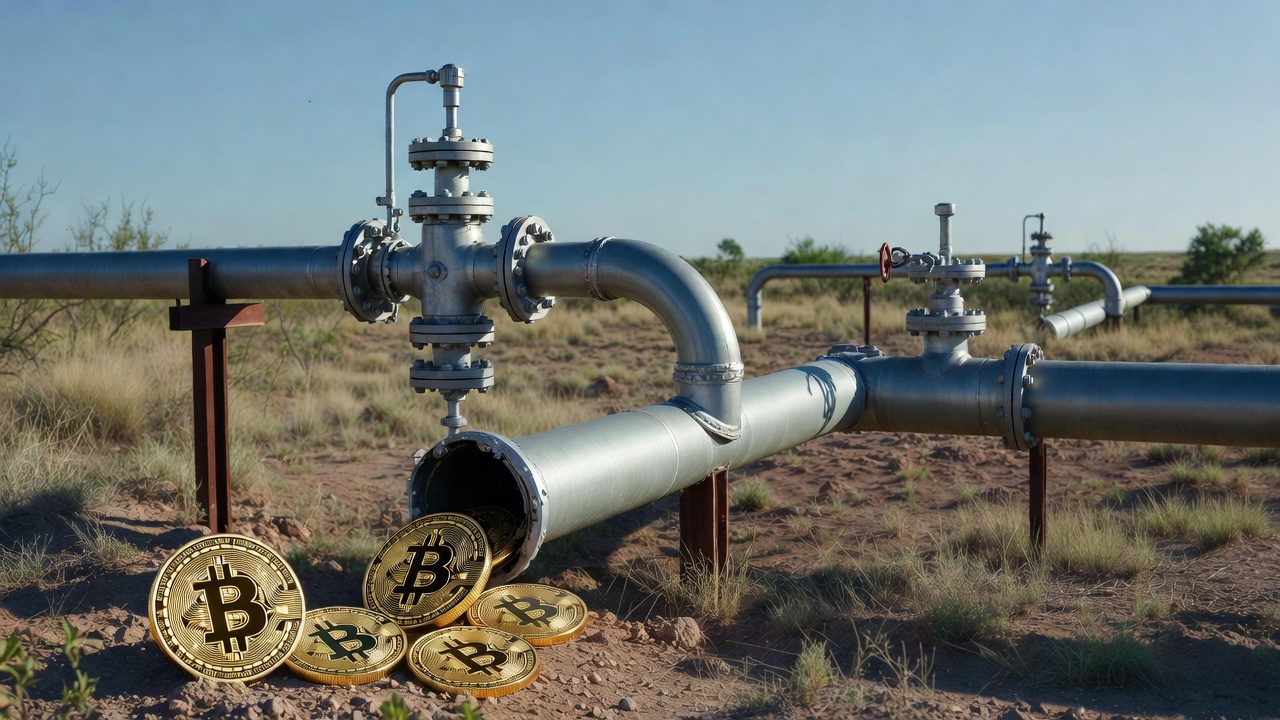
As demands grow on energy globally, Bitcoin miners are realising that to be more competitive especially in a lower Bitcoin price environment that they need to essentially produce their own electricity. This is where waste or stranded natural gas comes in. Astute miners are tapping into this abundant low-cost energy source with competitive advantages.
Bitcoin mining is quietly turning waste gas into hard money — especially in places like Texas — and that has big implications for miners’ costs and for investors looking at listed companies in this niche.
What’s happening in the oilfields?
In producing regions like the Permian Basin in Texas, huge amounts of “associated” natural gas are stranded: there’s no pipeline or local demand, so operators either flare it (burn it) or throttle production. Estimates suggest hundreds of millions of dollars’ worth of gas is wasted every year in the Permian alone.
Bitcoin miners are stepping in with mobile data centres and gas gensets, they:
- Park containers of ASIC miners next to a well.
- Route flared or stranded gas into a generator.
- Convert that gas to electricity on-site and mine BTC.
A number of companies have emerged like Crusoe Energy and Giga Energy who are doing exactly this with flare gas, including sites in Texas. Several listed UK Oil & Gas companies such as Bucanneer Energy and Mendel Helium are also exploring this lucrative means of turning waste energy into Bitcoin. In some cases, utlising this gas for Bitcoin mining on the side can help them increase production as they don’t need to throttle it.
Why Are some Miners Pivoting?
Fundamentally it comes down to the cost of electricity. Because this gas was previously waste, the effective fuel cost to the miner can be extremely low (often only generator capex + maintenance). Some operators report all-in power costs in the low single-digit cents per kWh when things are run well.
On top of that, burning gas in a high-efficiency generator instead of open flares can cut CO2-equivalent emissions significantly, because you’re destroying methane more completely while doing productive work. Crusoe, for example, has claimed large CO2-e reductions vs. flaring. This is a win-win situation for both the Oil & Gas companies and the miners!
Two-way advantage
Miners using gas to power their Bitcoin mining broadly benefit from both an increase and decrease in the price of Bitcoin, at least compared to miners using more expensive grid power, how’s that?
Network hash rate
The network hash rate is essentially the difficulty of mining Bitcoin. When the price of Bitcoin increases, hash rate difficulty also increases as there are more miners competing. When the Bitcoin price decreases, so does the hash rate/difficulty due to grid miners switching off machines thus resulting in less miners competing. Electricity can be up to 80% of the costs of mining a Bitcoin so miners have to be careful they don’t suddenly move into negative cash-flow!
Miners using the much cheaper gas alternative to mining don’t need to switch off and as such they can mine more Bitcoin due to the decrease in competition. So, these miners can benefit from a falling Bitcoin price, especially if they have a longer-term view on Bitcoin and are holding them in treasury.
Of course, if the price of Bitcoin goes up its harder for all miners to mine but their Bitcoin holdings/treasury will be increasing in value at the same time!
Meet Sterling Digital
Sterling have just listed on the Aquis growth exchange under the ticker ASIC. ASIC stands for Application-Specific Integrated Circuit. In Bitcoin mining, an ASIC is a chip designed for one job only — performing the SHA-256 hashing used to secure the Bitcoin network, so it’s an appropriate ticker!
The company is led by Stefan Michaelides and Dragan Jovanovic, CEO and COO respectively—both co-founders of Sterling. Stefan and Dragan have vast experience in the field of Bitcoin mining and its associated infrastructure. Sterling was born to essentially 'cookie-cut' what these guys have done before in a mostly consultancy capacity—with a listed company now focused on growing its own Bitcoin mining operation and treasury. It's the first natural/stranded gas focused UK listed Bitcoin miner.
It's important to note that Sterling is not just a treasury company, their main business is Bitcoin mining. The treasury is a by-product as listed companies need one to store Bitcoin and a treasury policy to go with it for regulatory purposes. Sterling could sell Bitcoin at any time to either manage OPEX or recycle Bitcoin into ramping up their mining operation. The company can also generate yield from the Bitcoin.
Sterling on IPO have raised £4M with a post-listing market cap of just £6.5M
Sterling will use the funds raised to purchase all the equipment necessary to start their first 3MW mining operation. This includes the gas to electricity generators and Bit Main S21 variant mining machines. In fact, the company has already purchased its first generators and is in discussion for its first "GPA's" (Gas Purchase Agreements), expected to be penned shortly.
A Clear Growth Strategy
Sterling will start with a fully funded 3MW operation powering the S21 machines. The company estimates at the current hash rate they will be able to mine 2.5 Bitcoin per month. The company has aggressive growth plans and is targeting an 150MW by 2027, that’s some c.50x the initial mining operation and depending on hash rate could equate to over 100 Bitcoin mined per month. For those that can do the maths at today’s Bitcoin price that could be a monthly cash equivalent value of some c. $8.7M per month. These are somewhat 'fag packet' calcs, there are many variables, but the potential growth in Bitcoin accumulation could dwarf the current market cap of just £6.5M
As mentioned earlier, Sterling will specialise in gas powered Bitcoin mining and as such will run at a very low OPEX of just $21k per Bitcoin, at today’s Bitcoin price of c.$87K that's a very healthy margin! In addition, as mentioned, if the price of Bitcoin drops, the hash rate will improve and should allow Sterling to mine more Bitcoin.
Sterling can also grow their mining operation incrementally and when it comes to further Capex funding they have options on the table with a variety of potential BTC backed debt options negating the need to go back to Capital markets if they wish.
The Bottom Line
Investors looking for Bitcoin and exposure to Bitcoin Miners (those using flared and stranded gas) could be emerging winners given the durability advantage of price decreases in Bitcoin and the upside when prices rise.
For a retail investor, the opportunity isn’t necessarily “gas miners are magic” — it’s that the lowest-cost, best-engineered operators in this niche are structurally better positioned across the BTC cycle and Sterling Digital are well positioned with their previous extensive experience in the space. At £6.5M cap and mining set to start in the new year, the growth potential and opportunity investors look for could well be realised in a very short timescale.
SmallCapPix talks to CEO, Stefan Michaelides and Chairman Guy Winterflood