
Buccaneer Energy: From Texas Turnaround to European Gas Growth

With Texas production more than doubling under the current management team, positive cash flow supporting the existing business and a new European onshore gas strategy targeting potentially much larger opportunities, Buccaneer Energy is beginning to look very different from the company inherited two years ago.
Buccaneer Energy (AIM: BUCE) is an international oil and gas company currently built around a portfolio of producing and development assets in East Texas.
For investors coming to the story for the first time, the interesting part is not simply what Buccaneer owns today, but the progress management has made with those assets and what it now intends to build on top of them.
The Texas business has moved from a period of underinvestment to positive cash generation, while management has now set its sights on a significantly larger opportunity: conventional onshore gas projects in Europe.
The Texas Foundation
Buccaneer's principal producing operation is the Pine Mills field in East Texas, a mature conventional oil asset covering approximately 2,300 acres.
Pine Mills is a relatively shallow, long-life oil field supported by modern 3D seismic and an established production and waterflood infrastructure.
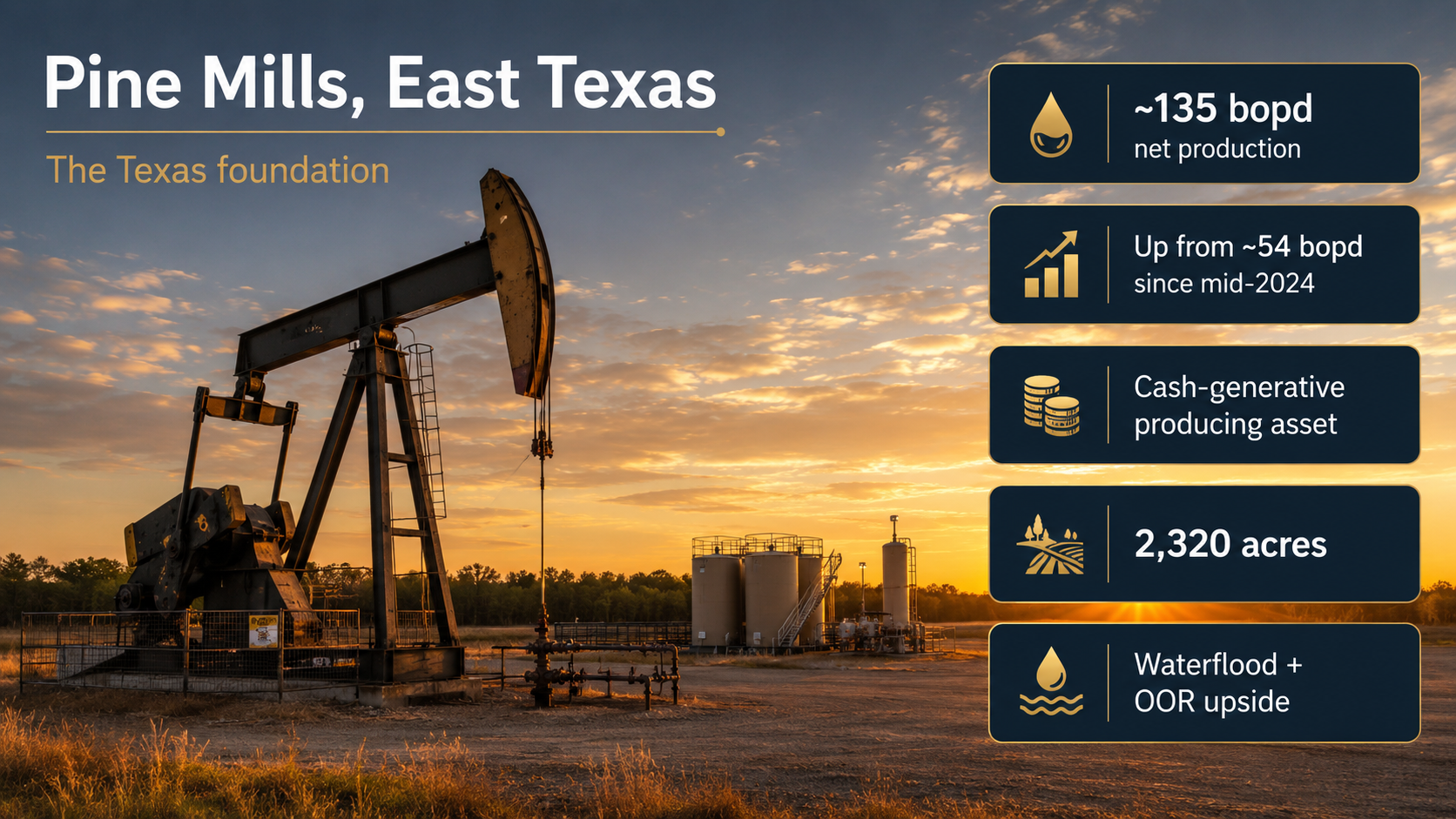
When the current management team took control of the business in mid-2024, Pine Mills was producing only around 54 barrels of oil per day following a period of underinvestment.
That figure provides a useful benchmark when assessing subsequent delivery.
Current average net production is approximately 135 bopd, meaning production has increased by around 150% since management took control.
The improvement has not simply come from spending heavily to chase production. Buccaneer has combined workovers, operating-cost reductions, selective investment and targeted acquisitions to rebuild the economics of the asset.
In May 2026, Pine Mills and the Fouke assets generated approximately US$250,000 of positive net cash flow, helped by realised oil prices above US$100 per barrel.
June was subsequently expected to generate approximately US$200,000 of positive net cash flow.
That cash generation is now sufficient to cover corporate overheads, comfortably service interest on legacy borrowings and, importantly, allow Buccaneer to begin reducing outstanding debt.
For a company of Buccaneer's size, that represents a significant change in financial positioning.
Carlisle-1 Shows the Strategy in Action
One particularly good example of management's approach has been the acquisition of the Carlisle-1 well in the Fouke area.
Buccaneer acquired a 100% working interest in Carlisle-1 for approximately US$425,000.
The well added around 25 bopd of production and has exceptionally low operating costs.
In May alone Carlisle-1 generated approximately US$65,000 of free cash flow, implying an acquisition payback period of just over six months at the pricing achieved during that month.
The acquisition did more than simply increase production.
It also lifted Buccaneer's working interest in the proposed Fouke enhanced-recovery unit to more than 50%, giving the company operational control over an asset that could potentially become an important additional production driver.
This is exactly the type of capital allocation small-cap investors generally want to see: modest expenditure, immediate cash flow and additional strategic value attached to the transaction.
Further Organic Upside in Texas
Management believes the existing Texas portfolio still offers meaningful scope for additional production growth.
The two principal initiatives are the Fouke waterflood project and Buccaneer's Organic Oil Recovery programme, or OOR.
The Fouke waterflood is currently expected to commence during Q4 2026.
Management believes that successful implementation could potentially double primary recovery volumes and increase remaining recoverable Fouke volumes to more than 500,000 barrels gross.
Buccaneer's increased ownership position following the Carlisle acquisition means it should also capture a greater proportion of any upside.
The OOR programme offers a different form of optimisation.
A pilot carried out alongside Hunting PLC produced a particularly encouraging result, with one treated well moving from approximately 90% water cut to effectively water-free production, with that performance sustained for several months.
The pilot added approximately 15 bopd.
That matters because handling and disposing of water represents a substantial operating cost at Pine Mills. Reducing water production therefore has the potential to improve both production and margins.
Management believes a wider field rollout could increase Pine Mills production by around 20%-30%, equivalent to approximately 25-45 bopd net.
Taken together, Carlisle-1, Fouke and OOR provide a pathway toward management's near-term organic target of approximately 200 bopd.
A Growing Reserve Base
The operational improvement is also beginning to show through in the reserve numbers.
Buccaneer's latest reserve review showed total net proved reserves rising by 18% to approximately 787,000 barrels.
The associated WAFD Bank borrowing-base valuation placed the company's proved asset base at approximately US$11.7 million NPV10, while the bank maintained a borrowing base of US$4.45 million.
Since the beginning of 2026, Buccaneer has said its reserves have increased by approximately 0.4 million barrels, while NPV10 has increased by around US$2.1 million.
For investors assessing a small E&P company, that reserve growth is important because it provides evidence that the operational progress is also translating into underlying asset value.
The Bigger Opportunity: European Gas
The most significant development in the Buccaneer story, however, may ultimately come from outside Texas.
Having stabilised the US business, management is now pursuing a new European conventional onshore gas strategy.
Buccaneer has entered into a technical partnership with Orion Resources, led by experienced petroleum geologist Roberto Bencini.
Roberto, a Chartered Petroleum Geologist and Technical Director at GA.I.A. srl, 1999-present, developed a strong international multidisciplinary experience in the energy sector, subsurface aspects, from 1981 with Gulf Oil, now Chevron and with Lasmo-ENI (www.eni.com) from 1985, and from 2002 to 2017 with the Independent Resources Group, with particular reference to oil & gas exploration and production (North Africa, Italy, North Sea, North America, SE Asia), underground gas storage (UGS), CO2 geological storage and unconventional gas (including CBM).
In the period 1989-2017, Roberto was instrumental in the following discoveries:
- Tempa Rossa oil field (440 million BOE recoverable reserves), Southern Italy;
- Berkine Basin discovery and appraisal (several fields, 3 billion bbls recoverable), Algeria;
- Ain Tsila gas condensate discovery (530 million BOE recoverable reserves), Algeria;
- Elephant (El Feel) oil field discovery (700 million bbls recoverable), Murzuq Basin, Libya;
- Bhit gas field (1.35 TCF recoverable), Pakistan;
- Ribolla CBM play (159.8 BCF recoverable), Central Italy
- Torrente Baganza gas field (53.3 BCF recoverable), Northern Italy.
Together, the teams have screened hundreds of European opportunities and are progressing an initial shortlist focused on Italy, the Czech Republic and Turkey.
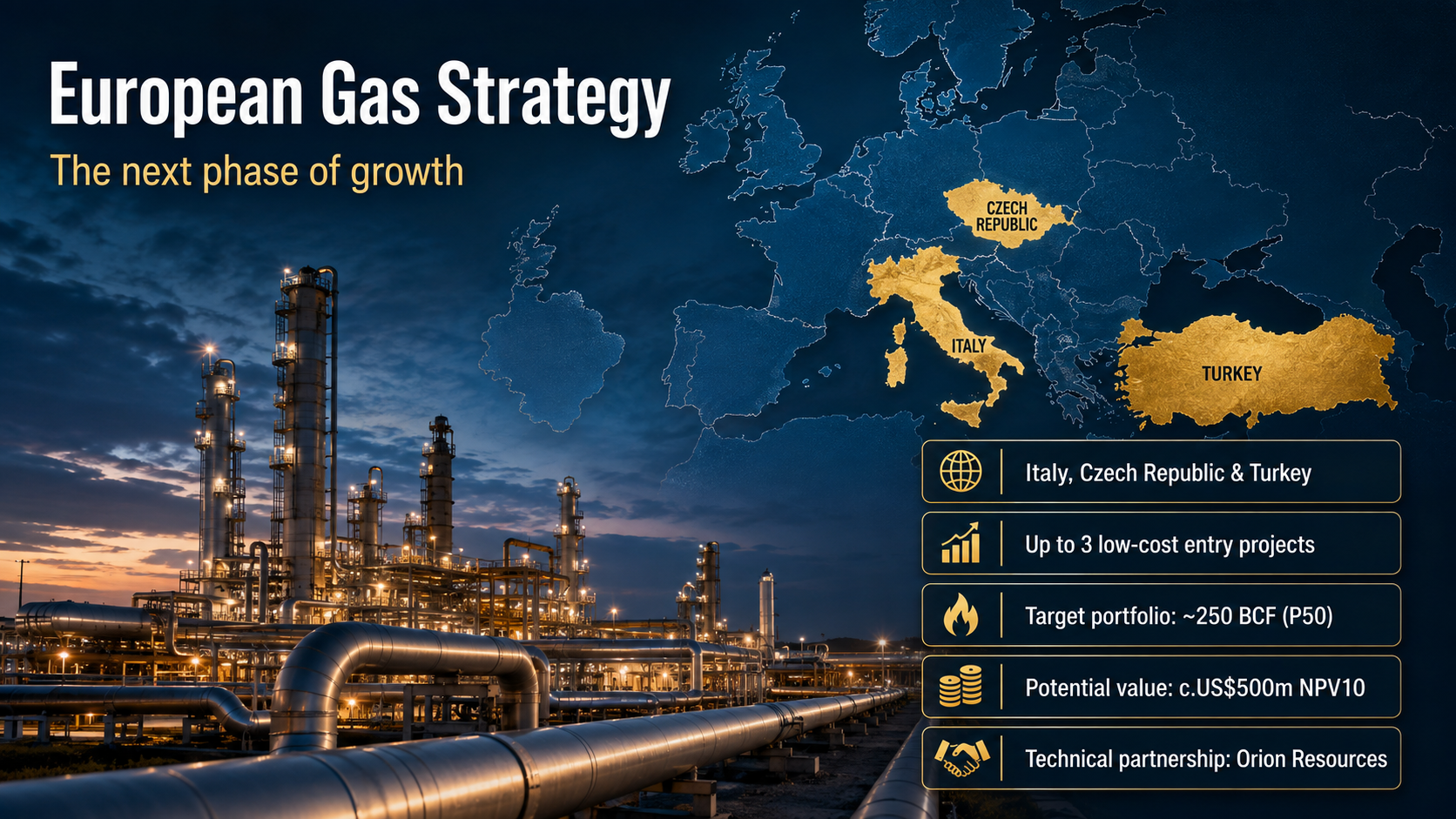
The company is initially targeting a portfolio of up to three low-cost entry projects.
At this stage these remain prospective opportunities rather than secured producing assets, but management has outlined a potentially substantial combined opportunity of approximately:
- 250 BCF P50 gas
- c.US$500 million NPV10
- c.US$28 million potential annual cash flow
Those numbers are clearly subject to further technical work, commercial evaluation and successful acquisition or participation agreements.
Nevertheless, they demonstrate the difference in scale between Buccaneer's existing Texas operations and what management is now attempting to build.
Why Europe, Why Now?
The rationale is based partly on the structural changes occurring in European energy markets.
European countries remain increasingly focused on energy security and domestic supply, while the loss of historic Russian pipeline volumes and continuing uncertainty around global LNG supply have strengthened the strategic case for locally sourced gas.
For a technically experienced junior E&P company, smaller conventional gas discoveries or overlooked development opportunities can potentially offer attractive economics without requiring the scale of capital associated with offshore mega-projects.
Chairman Dr Stephen Staley is playing a leading role in identifying and assessing these opportunities.
His background is notable.
Staley has previously founded and led several listed oil and gas companies and was involved with Cove Energy before and during the development of its Mozambique gas interests. Cove was subsequently acquired by PTTEP for approximately £1.2 billion.
That history does not guarantee Buccaneer will repeat anything approaching that outcome, but it does explain why management believes it has the technical and commercial network to evaluate international opportunities considerably larger than its current asset base.
Key Points
Buccaneer today arguably has two distinct parts to its investment case.
The first is a Texas production and cash-flow story that is already delivering.
Production has risen from approximately 54 bopd to around 135 bopd under current management, Carlisle-1 is generating attractive returns, the reserve base is growing and both Fouke and OOR offer additional near-term organic upside.
The second is the European growth opportunity.
This remains earlier stage and therefore carries materially greater execution risk, but it also introduces potential opportunities of a completely different scale.
The company's longer-term ambition remains to build Buccaneer into a mid-sized E&P business producing approximately 5,000 boepd within three to five years.
Why It Matters
The key question for investors is whether Buccaneer can use the cash-generative Texas business as a foundation from which to pursue larger opportunities without losing the capital discipline that has driven its recent turnaround.
So far, there is evidence of operational delivery.
Production has materially increased, costs have been controlled, acquisitions have generated rapid payback and debt reduction has begun.
The next stage will require a different skill set. The Company now has this in-house with Roberto Bencini and Steve Staley. Also, CEO, Paul Welch successfully developed lots of gas production as head of SDX.
Securing attractive European assets, negotiating sensible entry terms and progressing projects without excessive dilution will be important if the company's ambitions are to translate into shareholder value and Buccaneer certainly have an experienced team to be able to achieve this.
Investors should therefore watch both sides of the story closely.
Texas needs to continue generating cash and delivering the Fouke and OOR upside, while the European strategy needs to move from a screened opportunity set into tangible transactions.
The SmallCapPix Take
Buccaneer Energy is becoming an increasingly interesting small-cap E&P story, particularly sitting at just over £2M Market Cap.
The company inherited a Texas business producing around 54 bopd and has grown that to approximately 135 bopd, while improving costs, generating meaningful positive cash flow and strengthening its reserve position.
That alone provides evidence that management has been executing rather than simply talking about growth.
The next phase could be considerably more ambitious.
Texas now provides the foundation, but Buccaneer clearly wants to build something substantially larger through European onshore gas.
With the changing gas market dynamics in Europe, Buccaneer has set itself up with the expertise to take advantage and ahead of its peers which could yield a compelling and possibly transformational transaction or two in the near future.
The headline numbers attached to the initial European opportunity set are significant, although investors should remember that these remain targets under evaluation rather than booked assets or reserves.
If management can continue delivering in Texas while securing one or more genuinely attractive European projects on disciplined terms, Buccaneer could begin to transition from a small US oil producer into a much broader growth-focused E&P company.
For now, the combination of rising production, positive cash generation, organic Texas upside and a potentially material new European strategy makes Buccaneer one worth following closely as the next stage of the story unfolds.