
Orosur Mining: A Multi-Asset Gold Story Starting to Take Shape

With a maiden resource at Pepas, expanding shallow gold at Pepas West, major high-grade potential at APTA, first-ever drilling imminent at El Cedro and a second 100%-owned exploration project in Argentina, Orosur Mining is developing into a much broader gold story than the market may yet appreciate.
Introduction
Orosur Mining (AIM/TSXV: OMI) is beginning to emerge as one of the more interesting multi-catalyst junior gold stories on the London market.
The centrepiece is the 100%-owned Anzá Project in Colombia, a roughly 330km² land package in the prolific Mid-Cauca gold belt. Here, Orosur already has a maiden high-grade resource at Pepas, is defining additional shallow mineralisation at Pepas West, is drilling a substantial gold system at APTA and is now mobilising a rig for the first-ever drilling at the potentially much larger El Cedro gold-copper porphyry target.
Alongside that sits El Pantano in Argentina, another 100%-owned project where maiden drilling has confirmed what the company believes to be a major epithermal mineral system.
For investors, the attraction is the combination of something already tangible at Pepas with several separate routes to resource growth and discovery.
What’s New
The most recent developments have strengthened the case that Orosur is no longer simply a single-deposit exploration story.
At Pepas West, six new holes released in August demonstrated a broad, flat-lying zone of shallow gold mineralisation. Results included 10.2m at 5.77g/t Au from surface, including 2.45m at 22.3g/t Au, as well as 19.8m at 1.77g/t Au and 15m at 2.03g/t Au, both from surface.
Orosur now believes a surface mineralised zone perhaps around 10m thick is emerging across a wide area, typically grading between 1g/t and 5g/t Au. The company has described this material as potentially “free digging”, flat-lying, surficial oxide gold and considers it a high priority in any future near-term production scenario.
At APTA, the current drilling programme has also delivered major intersections. MAP107 returned 135.5m at 1.91g/t Au, including 49m at 4.06g/t Au, 26m at 7.15g/t Au and 13.8m at 12.73g/t Au. Importantly, the hole ended in mineralisation.
At El Cedro, meanwhile, a rig is now being mobilised for the first-ever drilling of a large gold-copper porphyry and associated epithermal system.
That gives Orosur three active value-creation fronts at Anzá at the same time.
Key Points
Pepas — The Foundation
Pepas is currently the most advanced asset within Anzá.
In February 2026, Orosur announced a maiden Mineral Resource Estimate comprising:
-
201,000 ounces of gold Indicated at 5.46g/t Au
-
18,000 ounces Inferred at 2.99g/t Au
The resource is shallow, starts at surface and is contained within a conceptual open-pit shell extending to around 100m vertical depth.
That matters because Pepas gives Orosur something many junior explorers do not yet have: a defined high-grade resource that can now move through economic studies, permitting and potentially toward feasibility.
The company has already stated that Pepas is progressing in that direction.
In our view, this gives the wider exploration story a valuable anchor. Investors are not simply relying on the next drill hole to prove that Orosur has gold. It already does.
Pepas West — Potentially Cheap Additional Ounces
Pepas West was discovered roughly 100m west of the main Pepas resource and initially produced a mixed set of results.
The picture has improved considerably.
Recent drilling has now confirmed an extensive shallow mineralised zone, with many holes starting in gold from surface.
The standout August results included:
- 6.4m at 2.81g/t Au from surface
- 6.85m at 2.18g/t Au from surface
- 10.2m at 5.77g/t Au from surface
- 19.8m at 1.77g/t Au from surface
- 15m at 2.03g/t Au from surface
Orosur believes this may represent a flat-lying surficial body around 10m thick, although the geology remains complex because some material appears heavily weathered and may have been remobilised.
From an investment perspective, the geological nuances matter less than the potential economics.
If Orosur can demonstrate a meaningful volume of shallow oxide gold close to an eventual Pepas development, those ounces could potentially be relatively simple and inexpensive to define and ultimately mine.
The company is therefore considering using a smaller auger rig to define the surface zone faster and more cheaply than through conventional diamond drilling.
That could make Pepas West a very useful addition to the existing Pepas inventory.
APTA — The Sleeping Giant?
APTA may ultimately prove to be one of the most important parts of the Orosur story.
The prospect has already seen around 40,000m of drilling, including numerous historically exceptional gold intersections.
Previous results include:
- 14m at 40.37g/t Au
- 59m at 9.61g/t Au
- 40m at 14.09g/t Au
- 18m at 14.14g/t Au
- 22m at 10.42g/t Au
- 23m at 17.4g/t Au
The problem historically was not a lack of gold.
It was understanding the geology well enough to establish continuity and build a coherent resource model.
Orosur believes it may now be solving that puzzle.
Its current interpretation suggests mineralisation is contained within silicified sediments and volcaniclastics bounded by two major faults roughly 100m apart within the Aragon fault zone.
The first hole under the new model, MAP106A, returned 229.7m at 0.88g/t Au, including several higher-grade intervals.
MAP107 then followed with the much stronger 135.5m at 1.91g/t Au, including 49m at 4.06g/t Au and 13.8m at 12.73g/t Au.
The company believes these results suggest the deeper high-grade mineralisation may be substantially more extensive than previously thought.
If additional drilling supports that interpretation, Orosur has explicitly raised the possibility of eventually developing a Mineral Resource Estimate at APTA.
That could potentially give the company a second defined resource within Anzá.
El Cedro — The Blue-Sky Catalyst
If Pepas is the foundation and APTA is the potential second resource story, El Cedro is the exploration catalyst that could materially change the scale of Anzá.
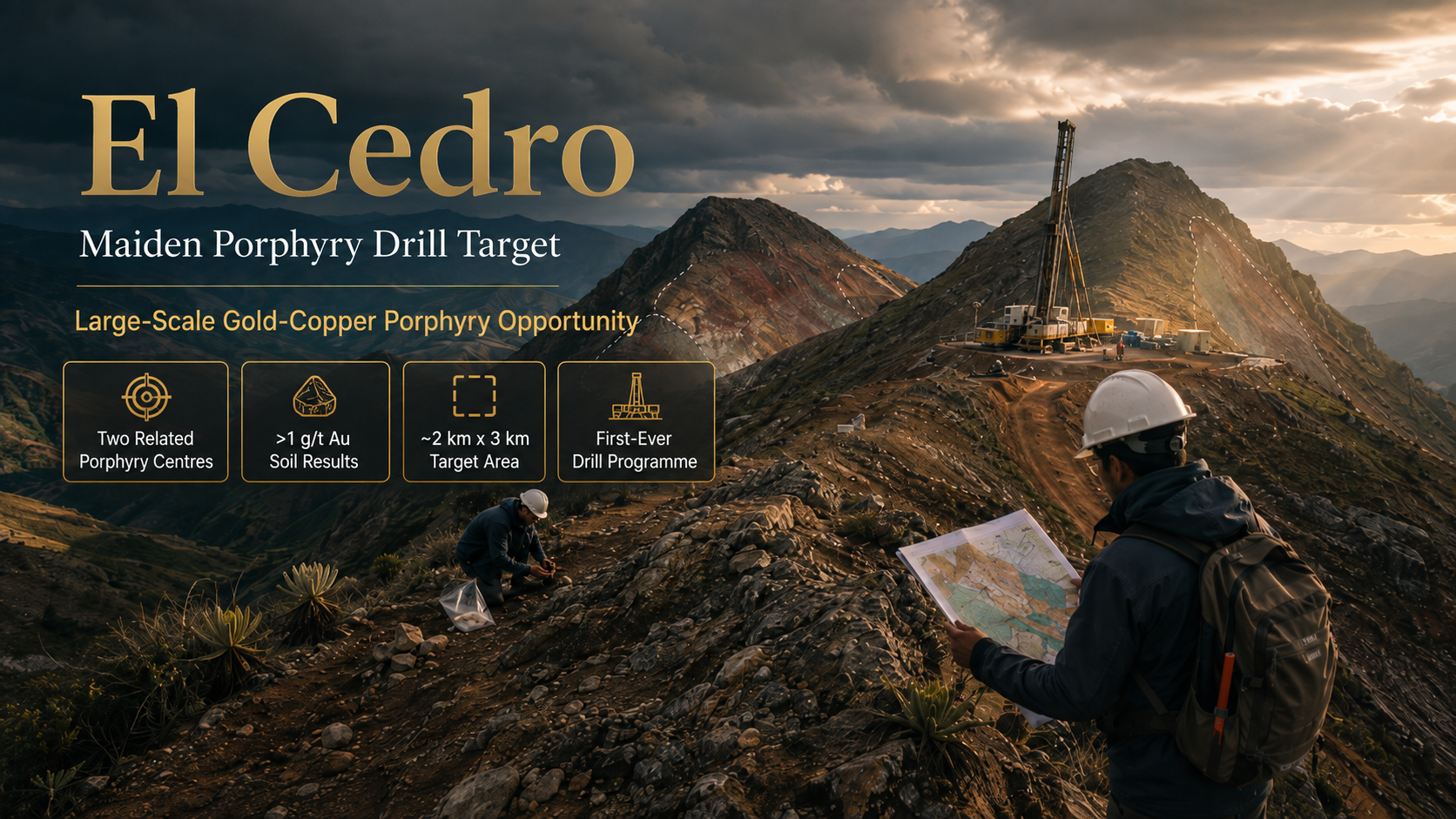
El Cedro lies approximately 4km south of APTA and consists of a cluster of gold-copper porphyry intrusions with associated epithermal mineralisation.
Historical work by Anglo American first identified a prospective gold-copper porphyry system, including vein samples returning more than 10g/t Au.
Orosur later expanded the work substantially.
A large-scale soil programme identified not just the known northern intrusive body, but a second southern body immediately adjacent to it.
Follow-up sampling over the southern area returned gold in soils above 1g/t Au in places across a broad area measuring roughly 2km by 3km.
Both intrusive centres lie within the same north-south structural corridor, and Orosur has noted that the strongest soil and rock-chip samples occur on their margins and within faults lying between them.
The company believes this may indicate porphyry-associated epithermal systems.
That creates an intriguing geological setup: potentially large bulk-tonnage porphyry mineralisation at depth alongside higher-grade epithermal or vein-style mineralisation closer to surface.
El Cedro remains completely undrilled, so investors should treat the scale potential as exactly that — potential.
But that is also what makes the upcoming drilling so important.
By August, Orosur confirmed that a rig was being mobilised for the first-ever drill programme at El Cedro.
A successful maiden hole here could become one of the most significant catalysts in the current Orosur investment case.
El Pantano — A Second 100%-Owned District-Scale Opportunity
Orosur also owns 100% of the El Pantano Project in Santa Cruz, Argentina.
El Pantano covers approximately 560km² in the Deseado Massif, around 45km from Cerro Vanguardia and roughly 100km southeast of Newmont's Cerro Negro mine.
Orosur completed the first-ever drilling at the project during late 2025 and 2026, drilling 24 diamond holes for a total of 5,533m.
The grades encountered so far are not comparable with Pepas or APTA, but that was not really the objective of the initial programme.
The purpose was to establish whether a substantial epithermal hydrothermal system existed.
Orosur believes the drilling has achieved that.
At El Pantano West, drilling has identified multiple structurally controlled gold-bearing vein corridors.
At El Pantano East, the company has identified silica caps, argillic alteration and broad pathfinder geochemistry that it believes may represent a better-preserved upper part of the hydrothermal system.
Orosur has therefore concluded that El Pantano hosts a significant epithermal mineral system worthy of further exploration.
For now, we see El Pantano as additional optionality rather than the core investment case.
But with 100% ownership of a 560km² project in a proven Argentine precious-metals province, it should not be ignored.
Why It Matters
The investment attraction of Orosur is the increasing number of ways the company can create value.
At one end of the spectrum, Pepas already provides a defined resource and a pathway toward development.
Pepas West could potentially add shallow, inexpensive ounces close to that existing resource.
APTA appears increasingly capable of developing into a second meaningful resource centre.
And El Cedro offers something different again: genuine discovery-scale upside from a large, entirely undrilled porphyry-epithermal system.
That mix is attractive because the investment case is not dependent on one binary event.
If El Cedro disappoints, Pepas and APTA remain.
If APTA takes longer to define, Pepas continues toward development.
If Pepas West proves larger than expected, it may improve the future production economics around Pepas.
And El Pantano offers another independent exploration opportunity outside Colombia.
What Investors Should Watch
The most important upcoming milestones in our view are:
- First drill results from El Cedro
- Further drilling at APTA, particularly the shallower eastern targets
- Progress toward a potential APTA Mineral Resource Estimate
- Definition drilling at Pepas West, including the proposed auger programme
- Economic study and permitting progress at Pepas
- Any future decision on the next phase of exploration at El Pantano
Of these, El Cedro is probably the most obvious short-term speculative catalyst, while Pepas and APTA provide the more substantial underlying investment case.
The SmallCapPix Take
Orosur Mining is beginning to look considerably more interesting than a simple junior exploration punt.
Pepas has already demonstrated that Anzá can host high-grade, near-surface gold mineralisation and has delivered a maiden 219,000oz resource.
Pepas West is now opening the possibility of adding shallow oxide ounces around an eventual development.
APTA is arguably the most intriguing established exploration asset. Almost 40,000m of drilling has already demonstrated that a substantial amount of high-grade gold exists there, and Orosur's new geological interpretation may finally provide the framework required to define its true scale.
Then there is El Cedro.
This is where the speculative upside becomes much larger. Two related intrusive centres, highly anomalous gold-in-soil results, high-grade surface samples and evidence of associated epithermal mineralisation make it a highly interesting maiden-drill target.
None of that guarantees a discovery at depth, and investors should remember that porphyry exploration can be technically challenging and capital intensive.
At a market capitalisation of around £70 million, Orosur is no longer being valued as an overlooked micro-cap where the exploration portfolio is effectively free. The market is clearly assigning value to Pepas and at least some of the wider potential at Anzá.
But that is also what makes the next phase interesting.
Pepas currently provides the defined resource base, while APTA has the potential to develop into a second meaningful resource centre. El Cedro introduces a very different scale of exploration opportunity, and Pepas West could potentially add relatively low-cost ounces close to a future development.
Orosur also reported US$11.57 million of cash at the time of its April quarterly update, giving it meaningful funding capacity for the current exploration programme without an obvious immediate need to return to shareholders for fresh capital.
So the valuation question is not whether Orosur is completely undiscovered. It is whether today's roughly £70 million valuation adequately reflects what Anzá could become if APTA continues to expand and El Cedro delivers a meaningful maiden discovery.
That is the investment case we find most interesting.
Orosur already has the resource.
It potentially has a second major gold system at APTA.
It may have additional shallow ounces at Pepas West.
And it is about to drill one of its largest undrilled exploration targets at El Cedro.
That combination of defined resource, resource-growth potential, funding runway and genuine discovery optionality is what puts Orosur Mining firmly on the SmallCapPix watchlist.