
Rome Resources Identifies New Tin Targets as Kalayi Growth Story Builds
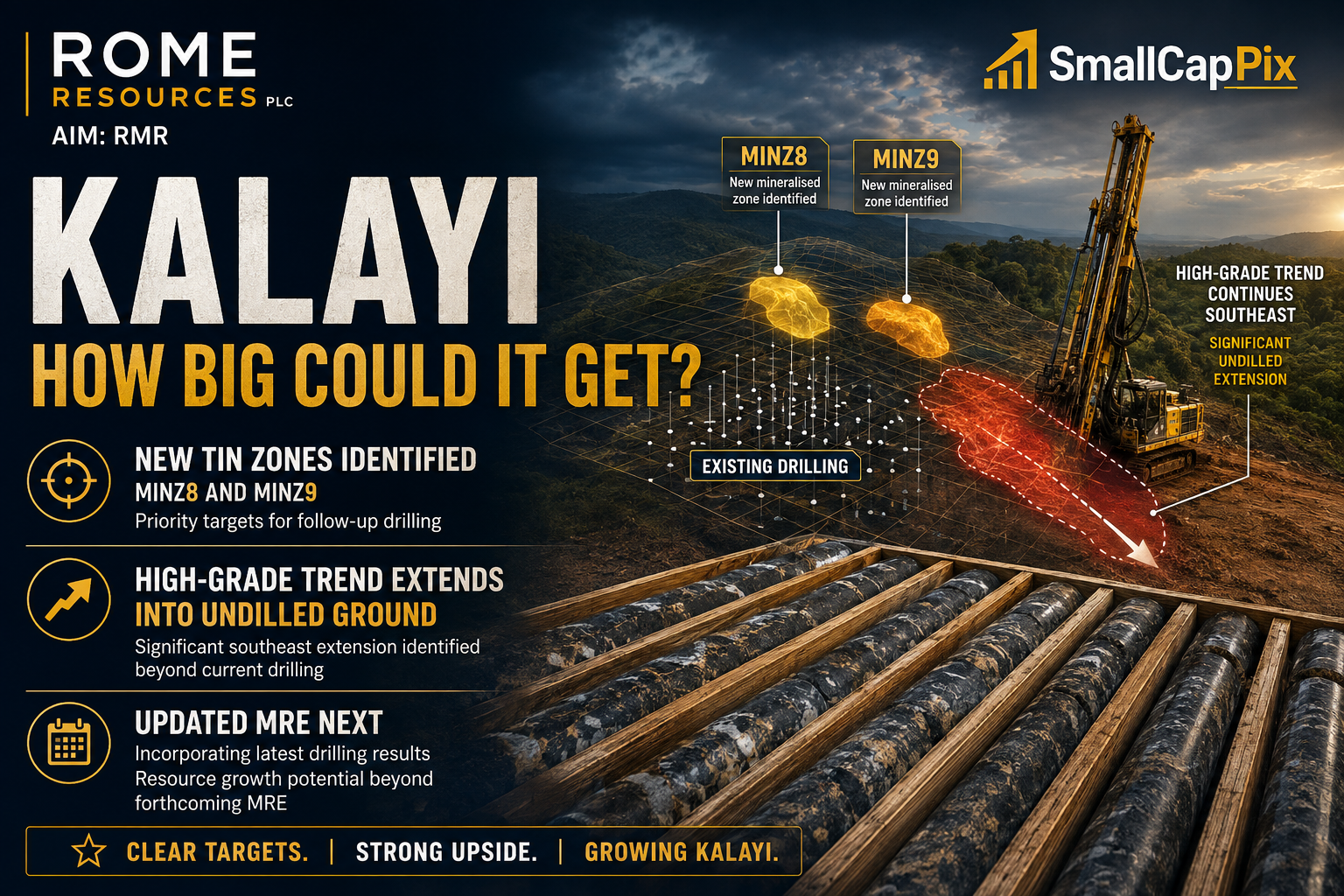
New mineralised zones and a significant undrilled continuation of Kalayi's high-grade tin trend suggest Rome Resources could have considerably more exploration upside beyond the resource currently being finalised.
Rome Resources' forthcoming updated Mineral Resource Estimate at Kalayi is already an important near-term catalyst, but the latest technical work suggests investors may soon need to start looking beyond that number.
Independent modelling by MSA Group has identified two additional mineralised zones, MINZ8 and MINZ9, together with a significant undrilled continuation of the high-grade tin trend southeast of existing drilling.
Crucially, these new targets will largely sit outside the forthcoming resource update.
That potentially gives Rome a second phase of resource growth to pursue after the new MRE is published, while airborne geophysics across the wider Bisie North Project and encouraging early exploration results from New Brunswick add further opportunities to the company's pipeline.
What’s New?
Independent consultants MSA Group are currently finalising the updated Mineral Resource Estimate for Rome's Kalayi tin deposit.
As part of that work, the geological modelling has identified two additional mineralised zones designated MINZ8 and MINZ9.
Both are currently supported by a single drill intersection in KBDD033 in the northern portion of Kalayi.
That hole was already notable.
KBDD033 intersected 19.5 metres grading 0.52% tin, together with additional shallower mineralised intersections.
MSA's modelling now suggests this drilling may have intersected previously unrecognised mineralised zones.
Further drilling will be required to establish sufficient geological continuity before MINZ8 and MINZ9 can potentially be incorporated into a future Mineral Resource Estimate.
Consequently, neither will be included in the MRE currently being finalised.
For investors, however, that exclusion could actually be one of the more interesting aspects of today's announcement.
The Resource Growth Story May Not End With the Next MRE
The updated Kalayi MRE has naturally become the immediate focus following Rome's recently completed drilling campaign.
The existing November 2025 MRE comprises an Inferred Mineral Resource of 0.33Mt grading 1.36% tin for approximately 4.47kt of contained tin.
Since then, drilling has produced wider mineralised intersections while continuing to encounter substantial high-grade zones.
Among the standout results from the latest campaign were:
-
9.5m at 2.05% Sn, including 6.0m at 3.12% Sn and 3.0m at 5.66% Sn
-
19.5m at 0.52% Sn
-
5.0m at 1.88% Sn, including 1.5m at 4.77% Sn
-
6.5m at 0.97% Sn, including 1.5m at 3.24% Sn
Across all mineralised samples from that campaign above a 0.5% tin cut-off, Rome reported a length-weighted average grade of 2.41% tin.
Those results are being incorporated into the forthcoming MRE.
But today's announcement indicates there is already identifiable mineralisation beyond the areas sufficiently drilled to resource density.
In other words, the next MRE potentially doesn't define the limits of Kalayi. It establishes the next baseline from which Rome can attempt to grow it further.
A Significant Undrilled High-Grade Extension
Perhaps the most interesting part of today's announcement is separate from MINZ8 and MINZ9.
MSA's block modelling has identified what Rome describes as a "substantial undrilled continuation of the high-grade tin trend" southeast of existing drilling.
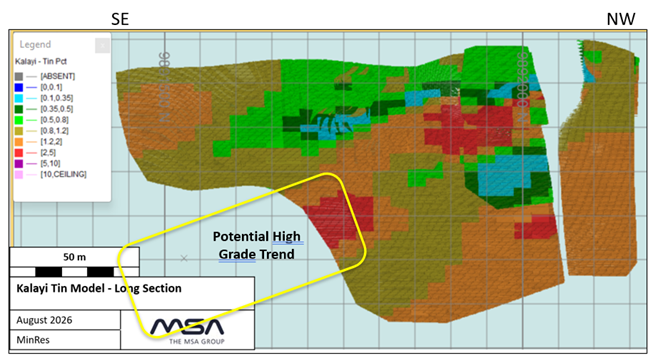 Section through MSA block model showing potential for high grade zones extending into undrilled southeastern area - Source: Rome Resources
This provides another clear target for future drilling.
There is an important distinction here.
Rome isn't reporting a new drill discovery in this southeastern area. Until it is drilled, its grade, width and continuity remain to be established.
What the modelling has done is identify where the geological interpretation suggests the existing high-grade system could continue beyond the current drilling footprint.
That gives Rome a technically defined target rather than simply drilling speculatively into unexplored ground.
If future drilling demonstrates that the high-grade mineralisation does continue southeast as interpreted, it could provide another route towards expanding Kalayi's resource footprint and contained tin inventory.
Kalayi Is Beginning to Develop Multiple Growth Fronts
This is perhaps the biggest takeaway from today's technical update.
Kalayi is no longer simply a case of drilling around one known mineralised zone.
Rome now has several potential avenues for additional growth:
The forthcoming MRE will capture the impact of drilling completed since the maiden resource.
MINZ8 and MINZ9 represent newly interpreted mineralised zones requiring further drilling.
The southeastern extension represents a potentially substantial continuation of the existing high-grade trend into undrilled territory.
And beyond Kalayi itself, Rome is still evaluating the much larger Bisie North licence package.
That increasingly creates the possibility of a rolling exploration programme where one resource milestone is followed by drilling aimed at establishing the next phase of growth.
Airborne Geophysics Could Open Up the Wider Bisie North Story
There is another potentially important catalyst approaching.
Southern Geoscience is currently interpreting the airborne geophysical survey recently completed across Bisie North, with results expected by the end of September 2026.
The programme should help Rome better understand the geological architecture across its licences and identify additional exploration targets.
Of particular importance will be understanding the relationship between tin mineralisation and the granite contact.
That work could also help refine the southeastern Kalayi target highlighted by MSA's modelling.
While Kalayi remains the obvious focus today, successful identification of additional targets elsewhere across Bisie North could ultimately broaden the investment proposition beyond a single deposit.
A Second Critical Minerals Opportunity Emerging in Canada
Rome is also beginning to provide the first indications from its newly optioned New Brunswick tin-tungsten-indium project in Canada.
Initial surface exploration has returned what the company describes as encouraging grab-sample assays.
Rome hasn't yet released the detailed results, so it would be premature to draw conclusions from them.
However, the company has already progressed to follow-up trenching, with assays and more detailed reporting expected subsequently.
This creates an interesting second strand to the Rome story.
Bisie North provides the advanced, high-grade tin opportunity in the DRC, while New Brunswick potentially gives the company exposure to an earlier-stage critical-minerals exploration project in Canada.
For now, Kalayi remains the asset doing the heavy lifting, but positive exploration results in New Brunswick could eventually provide investors with a second meaningful value driver.
The SmallCapPix Take
The next Kalayi MRE remains the number investors should be watching, but today's announcement arguably makes what happens after the MRE considerably more interesting.
Rome has already demonstrated that Kalayi can deliver some exceptional tin grades, with the latest drilling campaign recording a length-weighted average of 2.41% Sn across mineralised samples above the 0.5% cut-off.
Now independent modelling is beginning to show where the system might grow next.
MINZ8 and MINZ9 provide two additional mineralised zones requiring follow-up drilling, while the southeastern continuation of the high-grade trend could potentially become an important expansion target.
None of that potential should be treated as resource tonnes until further drilling proves continuity. But that is precisely why today's announcement matters: Rome appears to be developing a pipeline of targets capable of driving another phase of resource growth beyond the MRE currently being finalised.
And there is more happening in parallel.
Airborne geophysical interpretation is expected by the end of September, pilot mining continues to form part of Rome's development strategy at Kalayi, and the first exploration indications from New Brunswick are encouraging enough for trenching to have commenced.
The immediate catalyst remains the updated Kalayi MRE.
But increasingly, the investment case is becoming about something larger: how big can Kalayi ultimately become?
If the forthcoming resource grows meaningfully and subsequent drilling starts converting these newly identified targets into additional mineralisation, Rome could have a resource growth story extending well beyond the next announcement and one that could possibly catch the eye of one of the largest global tin mining companies next door—Alphamin!