
Blencowe Turns Graphite By-Product Into Potential High-Value Battery Opportunity
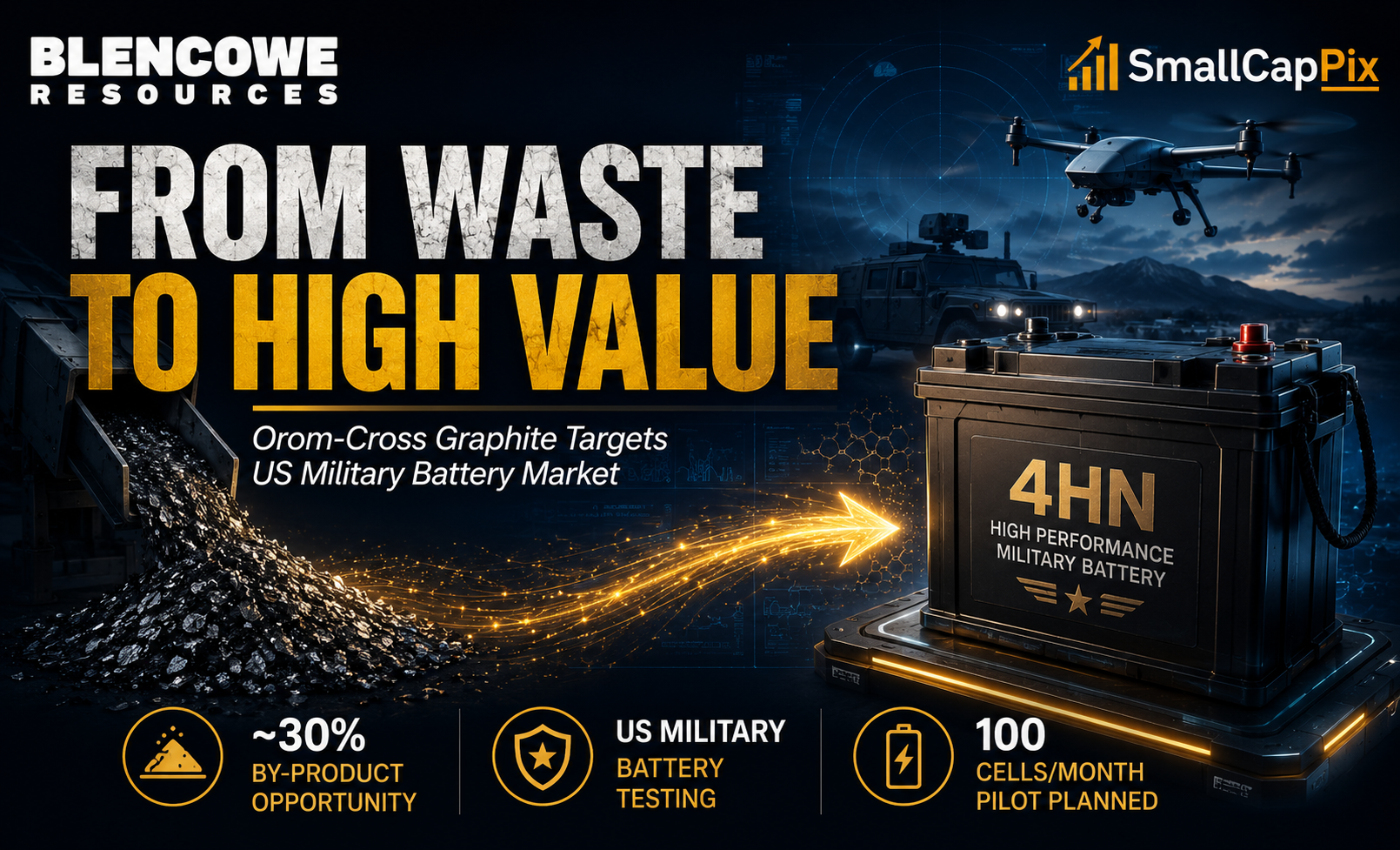
Blencowe Resources has delivered further successful battery testing for Orom-Cross graphite, opening potential markets spanning US military batteries, grid storage and data centres. Crucially, the programme could create a higher-value sales route for spheroidisation rejects representing approximately 30% of end product from its planned downstream beneficiation facility.
For a mining project, finding premium markets for your best material is important. Finding higher-value markets for what would otherwise be a lower-value by-product could be even more interesting.
Blencowe Resources has reported further successful testing of Orom-Cross graphite across advanced battery technologies, including work towards a prototype military battery designed to meet US Defence Logistics Agency specifications.
The results add another potential specialist market to a rapidly expanding list for Orom-Cross. But there is an important additional dimension: the graphite being evaluated is derived from spheroidisation rejects generated during Blencowe's planned battery-anode processing route, potentially turning approximately 30% of end product from the proposed beneficiation facility into another valuable sales stream.
What's New?
Blencowe is working alongside two US graphite and battery specialists, Apollo Energy Systems and American Energy Technologies (AETC), on several advanced battery applications.
The most eye-catching is a laboratory demonstration prototype targeting the 4HN high-performance military battery specification required by the US Defence Logistics Agency (DLA).
If prototype development is successful, the parties intend to establish a US pilot production line targeting 100 cells per month, providing a platform from which future commercial opportunities could potentially develop.
The work follows Blencowe's recent progress in anti-radar and electromagnetic interference shielding applications for UAVs and other defence platforms.
It means Orom-Cross graphite is now being evaluated across an increasingly diverse group of specialist markets encompassing military applications, lithium-ion batteries, advanced lead-acid batteries, grid storage, data centres, aerospace and defence.
That's becoming an important part of the Orom-Cross investment story.
Turning A By-Product Into Something More Valuable
Perhaps the most significant part of this announcement relates to exactly which graphite material is being used.
Blencowe's planned downstream strategy includes producing uncoated spheronised purified graphite (USPG) for the battery industry.
Spheronisation inevitably generates material that does not form part of the finished spherical graphite product.
Rather than simply accepting a relatively low value for these rejects, Blencowe has been investigating alternative markets.
AETC has transformed Orom-Cross spheroidisation rejects into a high surface area expanded delaminated graphite (HSAED) product.
That material has subsequently been successfully tested by Apollo as a performance-enhancing additive within advanced lead-acid batteries.
This potentially creates a considerably more attractive commercial pathway for material representing approximately 30% of end product from the planned beneficiation facility.
For investors, that's important.
A mine's economics are not determined solely by how much material it produces. They are also influenced by how effectively management can monetise the different products generated through processing.
Finding premium applications for material that might otherwise attract substantially lower pricing has the potential to improve overall product utilisation and ultimately enhance project economics.
What Does Orom-Cross Graphite Actually Do To The Battery?
The test results are particularly interesting because the graphite isn't simply replacing another raw material.
It appears to improve battery performance.
Testing undertaken by Apollo and AETC indicates that HSAED graphite produced from Orom-Cross material can improve the high-rate partial state-of-charge performance of advanced valve-regulated lead-acid batteries.
According to Blencowe, the programme has demonstrated improvements including:
-
Higher capacity
-
Greater charge acceptance
-
Longer battery life
-
Enhanced high-rate partial state-of-charge performance
These characteristics matter in applications where batteries are repeatedly charged and discharged or need to deliver reliable power under demanding conditions.
That includes military systems, grid storage, telecommunications infrastructure, start-stop applications and increasingly data centres.
A Military Battery Could Be The Next Demonstration
Apollo, AETC and Blencowe have spent the past six months constructing a demonstration battery designed to exceed the performance requirements of the 4HN military battery.

The 4HN programme is particularly interesting because it introduces another US defence-related application for Orom-Cross graphite.
The partners are currently fabricating and testing the laboratory prototype against specifications required by the US DLA.
Successful completion would not immediately mean large-scale commercial production, but the proposed next step is significant: establishing a US pilot line capable of producing 100 cells every month.
That would move the programme beyond laboratory validation towards repeatable pilot-scale manufacturing.
And this comes shortly after Blencowe revealed that Orom-Cross graphite is also undergoing testing in advanced anti-radar and EMI shielding coatings for UAV and defence applications.
A pattern is beginning to emerge.
Orom-Cross Is Becoming More Than A Lithium-Ion Battery Story
Graphite investment discussions frequently revolve around electric vehicles.
That's understandable because graphite is the largest material component by weight in most conventional lithium-ion battery anodes.
But Blencowe is increasingly demonstrating that Orom-Cross doesn't have to depend upon a single end market.
Advanced lead-acid batteries continue to play important roles across telecommunications, grid storage, military systems, backup power and data centres.
Blencowe estimates that the global lead-acid battery market represented approximately 75,000 tonnes per annum of graphite and carbon demand in 2021, based on the assumptions provided in today's announcement.
And the potential applications for the ultra-high-purity by-product stream extend further still.
AETC's processing route indicates potential suitability for lead-acid batteries, alkaline batteries, hearing-aid batteries, thermal lithium primary batteries, supercapacitors and fuel cells.
That product optionality could become increasingly valuable as Orom-Cross approaches production.
The AETC Results Are Building A Compelling Track Record
Today's announcement should also be viewed alongside previous independent testing.
Under AETC's earlier SAFELOOP programme, Orom-Cross graphite achieved 99.99 wt%C purity and, according to Blencowe, recorded the highest performance score AETC had seen for a natural graphite project.
Since then, testing has continued across a variety of increasingly sophisticated applications.
We've now seen Orom-Cross graphite progress through battery-anode work, aerospace and rocket propulsion testing, anti-radar/EMI applications and advanced battery technologies.
This growing body of independent technical validation is important.
Rather than relying solely upon geological grade or laboratory concentrate specifications, Blencowe is increasingly demonstrating how its graphite actually performs within potential customers' products.
That's ultimately what matters when trying to secure high-quality offtake partners.
Why Data Centres Could Be Particularly Interesting
One application mentioned in the announcement deserves particular attention: data centres.
The rapid construction of AI and cloud-computing infrastructure is creating enormous demand for reliable electricity and backup power.
Data centres cannot afford interruptions, making resilient battery systems a critical component of their infrastructure.

Advanced lead-acid batteries remain relevant within backup and uninterruptible power systems, while grid-scale storage requirements are also growing alongside increasingly complex electricity networks.
If Orom-Cross graphite can improve battery charge acceptance, capacity and longevity, these applications could provide another substantial addressable market outside conventional EV battery demand.
It is another example of why Blencowe's multi-market approach makes strategic sense.
From Graphite Mine To Advanced Materials Supplier
There is now a broader story developing around Blencowe.
Orom-Cross was originally relatively straightforward to understand: develop a large, low-cost graphite resource in Uganda and sell concentrate into international markets.
The strategy today is considerably more ambitious.
Blencowe wants to beneficiate material in Uganda, produce higher-value graphite products and build multiple sales channels into Western markets.
Recent announcements have included planned spheronisation and purification, expandable graphite, rocket propulsion testing, anti-radar coatings and now advanced battery additives.
Each successful application potentially provides management with another option when determining where individual fractions of Orom-Cross production can generate the greatest value.
That could ultimately prove far more important than simply maximising tonnage.
Key Points For Investors
Military exposure: A prototype using Orom-Cross graphite is being developed towards US DLA 4HN military battery specifications.
Pilot production: Successful prototype development could lead to a US pilot line targeting 100 cells per month.
By-product monetisation: Spheroidisation rejects representing approximately 30% of end product from the proposed beneficiation facility could potentially access higher-value markets.
Multiple markets: Potential applications now include military batteries, grid storage, data centres and other specialist energy-storage technologies.
Independent validation: AETC and Apollo continue to demonstrate the performance characteristics of Orom-Cross graphite.
Product optionality: The programme complements Blencowe's lithium-ion battery, expandable graphite, aerospace and defence opportunities.
Why It Matters
The significance of today's announcement isn't simply another successful battery test.
It's about extracting more value from every tonne of Orom-Cross graphite.
If Blencowe can sell its primary graphite products into established battery and industrial markets while simultaneously directing different fractions and processing by-products towards premium specialist applications, the overall revenue potential of the project could become considerably more diversified.
It also reduces dependence upon any single graphite market.
That diversification is particularly relevant at a time when Western governments and manufacturers are seeking critical mineral supply chains outside China.
A Ugandan graphite project capable of feeding multiple Western industrial, battery and defence applications therefore presents a rather different proposition from a conventional graphite concentrate producer.
The SmallCapPix Take
Blencowe's recent news flow is starting to reveal what could become one of the most interesting aspects of the Orom-Cross investment case: product optionality.
The company isn't simply trying to prove that it can produce graphite. That has already been extensively demonstrated.
It is increasingly asking a more commercially important question: where can each part of Orom-Cross production generate the greatest value?
Today's announcement provides a good example.
Spheroidisation rejects might ordinarily be considered a secondary product stream. Instead, Blencowe, AETC and Apollo are demonstrating that this material could become a performance-enhancing component within advanced batteries serving military, grid-storage and data-centre markets.
With approximately 30% of end product from the planned beneficiation facility potentially represented by this stream, successfully creating a higher-value market for it could be meaningful.
Add this to the company's recent progress in anti-radar coatings, aerospace applications, downstream processing and its wider offtake strategy, and Orom-Cross is increasingly developing into something more sophisticated than a conventional graphite mining project.
Funding remains the major gatekeeper to first production, but Blencowe continues to strengthen the commercial proposition behind that funding requirement.
And perhaps most importantly, every successful test appears to give management another potential answer to the same question:
How do we extract the maximum possible value from Orom-Cross?