
European Green Transition Interim Results: Wind Services Acquisition Starts to Deliver
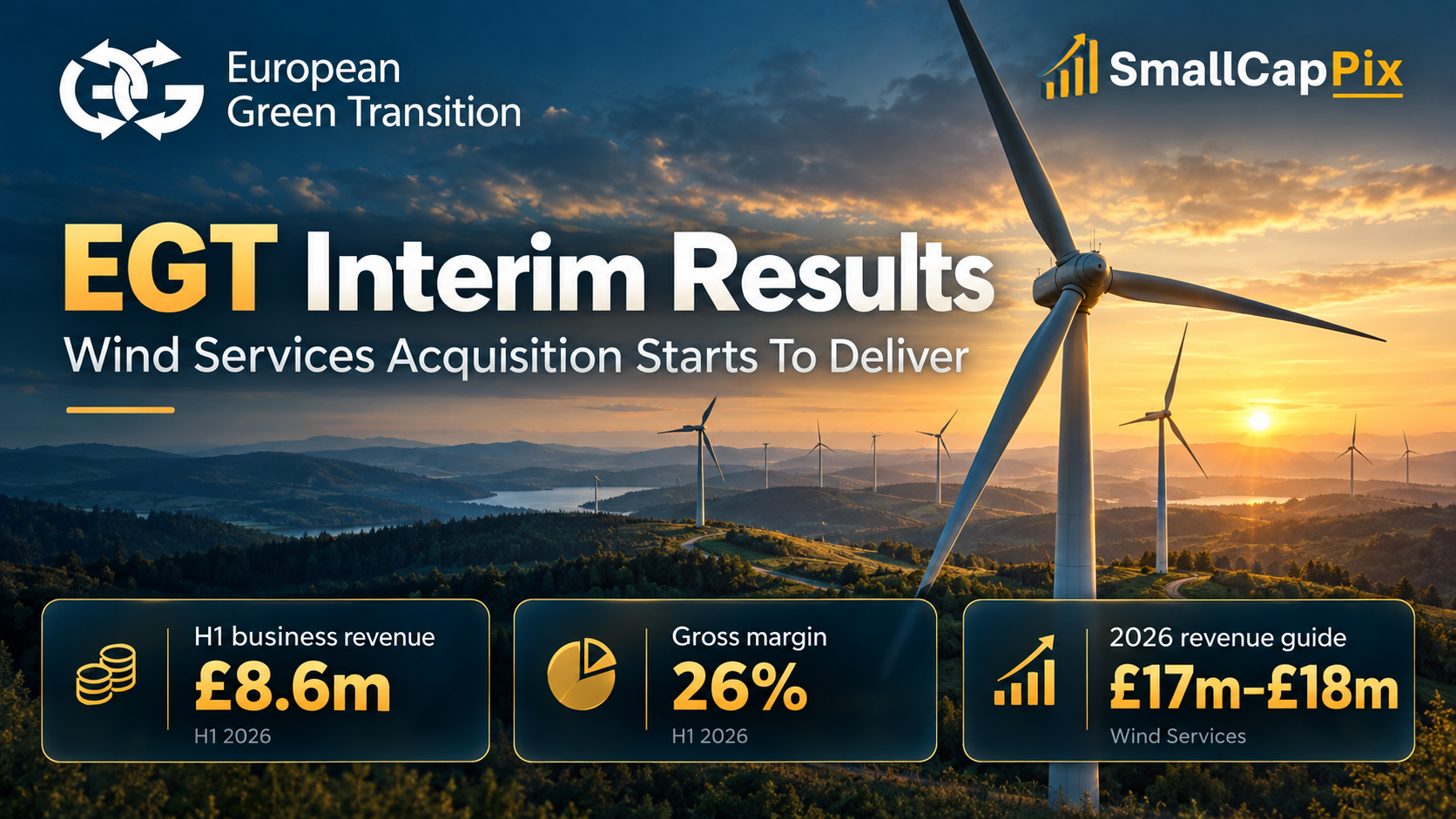
Strong first-half trading, a 26% gross margin and a £126 million potential repowering opportunity provide an increasingly visible platform for EGT's medium-term ambition of £50 million annual revenue and double-digit EBITDA margins.
European Green Transition plc has published its interim results for the six months ended 30 June 2026, providing investors with the clearest financial picture yet of the company following its transformational move into wind and critical infrastructure services.
The numbers show that the newly acquired Wind Services business has started strongly, generating £8.6 million of revenue during the period, while EGT recognised approximately £6.8 million of statutory revenue in the four months following completion of the acquisition.
More importantly, EGT generated gross profit of £1.76 million at a gross margin of approximately 26%, while management says the Wind Services business contributed positively to the Group, particularly during the second quarter as project and repowering activity accelerated.
With £5.8 million of cash, no debt highlighted in the update, a rapidly expanding repowering pipeline and full-year Wind Services revenue guidance of £17 million to £18 million, EGT now looks very different from the exploration-led business investors knew little more than six months ago.
What’s New?
The headline development is that investors can now see the first meaningful profitability metrics from EGT's acquired Wind Services platform.
The acquisition of Earthmill Maintenance, WEP Wind Energy Partnership, Silverford Engineering and Anemos Analytics completed on 25 February 2026, following an upsized and oversubscribed £7.5 million fundraise.
Across the full six-month period, the Wind Services business generated £8.6 million of revenue.
Because EGT only owned the businesses from late February, approximately £6.8 million of revenue was recognised within EGT's statutory interim results.
That revenue generated gross profit of £1.76 million during the four months following completion, representing a gross margin of approximately 26%.
This is an important new datapoint.
Previous operational and trading updates had demonstrated revenue momentum and a rapidly expanding repowering pipeline. The interim results now provide an early indication of the economics sitting underneath that growth.
The Group recorded an adjusted EBITDA loss of £0.58 million for the period, compared with a £0.66 million loss in H1 2025.
However, management says the Wind Services business contributed positively to the Group, with particularly strong performance during Q2 as project and repowering delivery increased.
Key Points
£8.6 Million of Wind Services Revenue
The Wind Services business generated £8.6 million of revenue during H1 2026 across its operations and maintenance, engineering, monitoring and repowering activities.
EGT itself recognised approximately £6.8 million because only four months of trading following completion were consolidated into the Group accounts.
26% Gross Margin Provides First Look at Profitability
One of the most significant additions in today's results is the gross margin.
EGT generated £1.76 million of gross profit from approximately £6.8 million of statutory revenue, representing a gross margin of around 26%.
For investors assessing EGT's longer-term potential, this number is arguably as important as revenue growth itself.
Management's stated medium-term objective is not simply to reach £50 million of annual revenue, but to deliver double-digit EBITDA margins alongside it.
The interim results therefore provide an early indication that the acquired operations have the potential to generate meaningful profitability as scale increases.
There is still a substantial journey from gross margin to EBITDA margin, with central costs and ongoing investment in growth needing to be absorbed.
Nevertheless, a 26% gross margin provides a useful starting point.
Repowering Remains the Major Growth Opportunity
Repowering continues to stand out as one of the most important potential growth drivers within EGT.
As at 30 June 2026, the Group had:
- 65 signed Heads of Terms
- 30 planning approvals
- 20 project commencements with deposits received
- 8 completed repowering projects
- approximately 280 qualified prospects
- a client base of approximately 900 turbines
EGT estimates that the qualified repowering pipeline represents a potential revenue opportunity of approximately £126 million.
It is important to distinguish that figure from contracted revenue.
The £126 million represents the potential value of the opportunity across qualified prospects rather than firm orders.
However, the progression from prospects through Heads of Terms, planning approvals, deposits and ultimately completed projects provides investors with a useful framework for assessing conversion.
Anemos Analytics Expands to 133 Turbines
EGT increased its ownership of Anemos Analytics from 52% to 79% in May.
By the end of June, Anemos was contracted across 133 turbines in the UK.
The monitoring business could become strategically important because it gives EGT another point of engagement with turbine owners.
Remote monitoring and analytics can help identify performance issues and maintenance requirements before they develop into larger operational problems.
In time, those customer relationships may also provide opportunities for repairs, engineering work and potentially repowering.
The combination of monitoring, maintenance and repowering increasingly gives EGT the ability to participate across several stages of a turbine's operational lifecycle.
£5.8 Million Cash Provides Room to Grow
EGT ended June with approximately £5.8 million of cash.
The balance sheet was strengthened earlier in the year through the £7.5 million fundraising completed alongside the Wind Services acquisition.
That financial position could prove important as EGT scales project delivery and evaluates further acquisitions.
Working capital can become increasingly important as infrastructure businesses grow, particularly when larger projects require equipment, engineering capacity and personnel before customer payments are fully received.
A meaningful cash balance therefore gives EGT greater flexibility as the repowering orderbook expands.
It may also support management's stated strategy of pursuing selective bolt-on acquisitions.
Acquisition Strategy Remains Active
EGT continues to look beyond wind services.
Management says it is targeting selective bolt-on acquisitions across the wider critical infrastructure sector in the UK, Ireland and Europe.
Potential areas include:
- energy
- renewables
- water
- other essential infrastructure services
This suggests the Wind Services transaction may ultimately represent the first stage of a broader buy-and-build strategy.
The potential attraction is straightforward.
EGT can use its existing operational platform, management infrastructure and balance sheet to add complementary businesses while potentially cross-selling services across a broader customer base.
The challenge will be maintaining acquisition discipline.
Investors will therefore need to consider not only the revenue added by future deals, but also purchase multiples, funding structures, integration risk and the quality of the earnings being acquired.
Exploration Assets Could Provide Additional Optionality
The legacy exploration portfolio has not disappeared from the investment case.
EGT says it continues to engage with multiple parties regarding potential sales and/or partnerships involving its exploration assets.
Management points to improving market conditions for both Rare Earth Elements and copper.
For shareholders, this potentially creates optionality.
If EGT can monetise or partner its exploration interests while continuing to focus operational resources on infrastructure services, those assets could potentially deliver value without distracting management from the core Wind Services growth strategy.
No transaction has yet been announced, so investors should treat this as potential rather than realised value.
Why It Matters
These interim results begin to answer one of the biggest questions surrounding EGT's transformation.
Can the company turn the Wind Services acquisition into a genuinely profitable and scalable platform?
The first evidence is encouraging.
Revenue is growing, the business is generating a healthy gross margin, the acquired operations are already contributing positively and the repowering pipeline continues to expand.
At the same time, EGT has approximately £5.8 million of cash and continues to guide towards £17 million to £18 million of Wind Services revenue this year.
The medium-term target remains £50 million of annual Group revenue and double-digit EBITDA margins.
That remains a substantial step up from the current business.
However, investors can now begin to see the potential building blocks:
recurring maintenance activity, growing monitoring revenue, higher-value repowering projects and potentially further bolt-on acquisitions.
The strategic logic is becoming increasingly clear.
From £17–18 Million Towards £50 Million
The next phase will be about execution.
At the midpoint of current guidance, the Wind Services business is expected to generate approximately £17.5 million of revenue during 2026.
To reach £50 million of Group revenue, EGT will therefore need to almost triple the scale of the current revenue base.
That growth could potentially come from a combination of organic growth and acquisitions.
Repowering is likely to play a central role.
Even partial conversion of the £126 million qualified opportunity could materially increase annual revenue over time.
Further expansion of maintenance contracts and Anemos monitoring services could add recurring revenue alongside those larger projects.
Meanwhile, selective acquisitions could accelerate the journey towards scale.
The key question will increasingly shift from whether EGT can grow revenue to whether that growth can be delivered at attractive margins and converted into sustainable cash generation.
The SmallCapPix Take
The interim results provide another important piece of evidence that EGT's transformation is gaining traction.
The £8.6 million of Wind Services revenue is encouraging, but the standout new figure is arguably the 26% gross margin.
That gives investors their first meaningful indication of the profitability characteristics of the acquired operations.
EGT has only owned the businesses since late February, meaning the interim period captures the very early stages of integration.
With £17 million to £18 million of full-year Wind Services revenue expected, H2 should provide a much clearer indication of what the enlarged Group can generate once it benefits from a full six months of trading.
Meanwhile, repowering continues to offer substantial upside.
There are now 65 signed Heads of Terms, 20 projects with deposits received and eight completed projects, sitting within a broader £126 million potential opportunity.
The £126 million figure is not contracted revenue, but the increasingly visible progression of customers through the pipeline suggests investors now have a tangible way of tracking execution.
Perhaps the most interesting part of the EGT story is that the investment case is beginning to move beyond simply proving the acquisition worked.
The next question is how large the platform can become.
With the Wind Services business contributing positively, a healthy gross margin, £5.8 million of cash and further acquisitions under consideration, the foundations for the £50 million revenue target are becoming easier to identify.
For EGT, the remainder of 2026 will be about proving that early momentum can translate into sustainable profitability and scalable growth.