
United Oil & Gas Clears Another Jamaica Hurdle as Focus Turns Firmly to Farm-Out
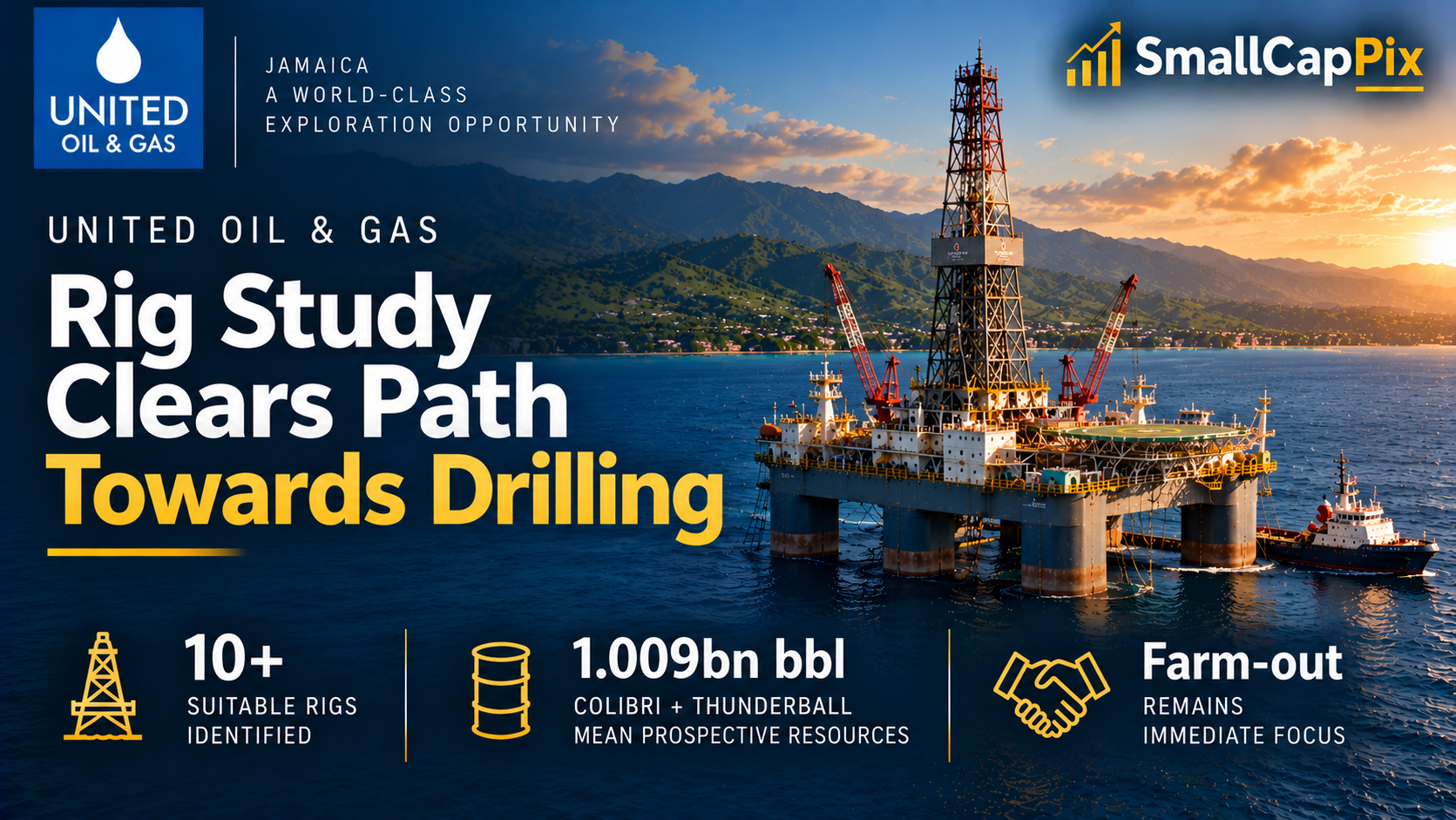
United Oil & Gas has completed its drilling-readiness study for Jamaica with positive results, identifying a double-digit pool of suitable rigs, a Jamaica-based logistics solution and the long-lead equipment required for a future exploration campaign. With a practical pathway now established for drilling the billion-barrel Colibri and Thunderball targets, management says its immediate focus is firmly on concluding the Walton-Morant farm-out.
United Oil & Gas (AIM: UOG) has delivered another potentially important piece of the Walton-Morant puzzle.
Last month, we looked at the company's decision to appoint NRG Well Management to establish what would be required to turn its huge Jamaican exploration opportunity into an executable drilling programme.
We now have the results — and they appear encouraging.
NRG has identified a double-digit pool of suitable drilling rigs, established the key long-lead equipment requirements and procurement timelines, and outlined a Jamaica-based logistics model capable of supporting a future offshore exploration campaign.
Importantly, this work was conducted in parallel with United's ongoing farm-out process.
From a Conceptual Well to an Executable Campaign
United has spent years developing the geological case for Walton-Morant.
The company has approximately 2,250km² of 3D seismic, a substantial inventory of prospects and leads and, more recently, additional geochemical evidence supporting the potential for a working petroleum system.
But identifying an attractive exploration target and actually drilling it are two very different things.
A prospective farm-in partner needs to understand whether appropriate rigs are available, potential drilling windows, which equipment must be ordered well in advance and how an offshore campaign could practically be supported.
The NRG study provides much of that information.
Its assessment covers both Colibri, in approximately 750 metres of water, and the much deeper Thunderball, at around 1,900 metres.
That means United can now provide potential partners with considerably more detail about how a future drilling campaign could actually be delivered.
Colibri + Thunderball = More Than 1 Billion Barrels
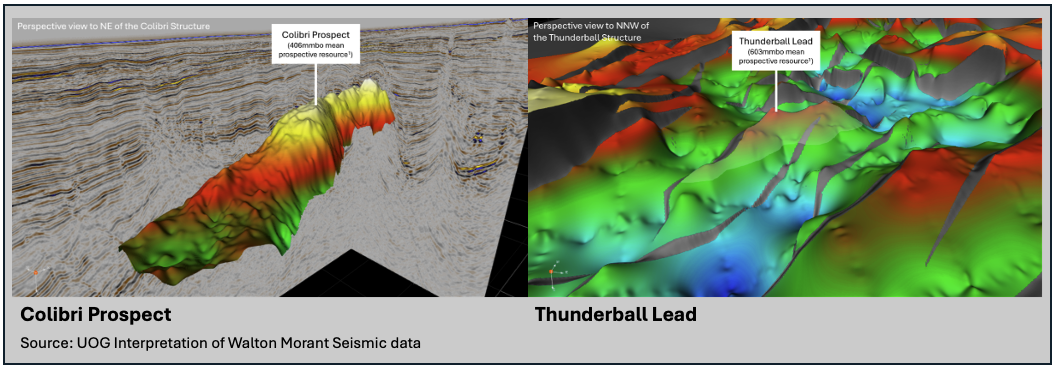
The scale of the two principal targets helps explain why this matters.
- Colibri — 406 MMbo mean prospective resources
- Thunderball — 603 MMbo mean prospective resources
Together they contain 1.009 billion barrels of mean prospective resources, with the study retaining the flexibility for both potentially to be targeted within a single exploration campaign.
Thunderball also forms part of a wider series of large tilted fault-block structures within the Morant Basin, adding another potentially interesting dimension to the exploration opportunity.
These are, of course, prospective resources rather than discovered reserves. Only drilling can establish whether commercial hydrocarbons are present.
But United is increasingly defining what it would actually take to answer that question.
Jamaica Could Provide the Operational Base
Another encouraging finding is that Jamaica itself could provide much of the logistical infrastructure required to support a future campaign.
NRG identified existing capabilities including port and project cargo operations, storage and laydown facilities, heavy lifting, marine fuel supply, customs and freight forwarding.
Specialist offshore services and equipment could then be sourced from established regional centres.
This potentially gives United and a future partner a practical model combining a Jamaica-based operational hub with the wider Caribbean and Americas offshore supply chain.
NRG has also identified the principal long-lead equipment requirements and engaged with suppliers regarding availability, sourcing and procurement timelines.
That gives United greater visibility over the critical path between making a drilling decision and potentially spudding a well.
It doesn't mean United has committed to drilling.
It means that if the commercial pieces fall into place, more of the operational groundwork has already been completed.
Why This Matters to a Potential Farm-Out
For SmallCapPix, this is the central point from today's announcement.
United specifically says the study was progressed “in parallel with, and in support of” its farm-out process.
CEO Brian Larkin says it now gives prospective farm-in partners: “immediate, practical and usable information” on how a future exploration campaign could be delivered.
That's important.
A potential partner can now assess Walton-Morant with greater visibility over not only its geological potential but also the operational pathway towards testing it.
United can demonstrate that it has investigated the targets, rigs, equipment, procurement timetable and logistics required for a potential campaign.
That doesn't remove the geological risk.
But it potentially removes some of the execution uncertainty surrounding what happens after a farm-out.
The Recent Sequence Is Becoming Interesting
Today's announcement is also worth considering alongside United's recent progress.
The company has continued building the geological case for Jamaica, including its piston-coring programme and identification of C4 and C5 hydrocarbons consistent with a potential thermogenic contribution.
It then strengthened its senior management team by promoting Donal Meehan to Chief Operating Officer, with his appointment specifically linked to operational readiness and advancing the farm-out.
United subsequently commissioned NRG to investigate the practical requirements of drilling Colibri and Thunderball.
That work has now been completed successfully.
There is an obvious progression:
Geological evidence → active farm-out → strengthened operational management → drilling-readiness study → clear execution pathway.
None of this tells us that a farm-out agreement is imminent.
But United's stated priority now leaves little room for ambiguity:
“Our immediate focus remains on concluding the farm-out process.”
And Colibri and Thunderball Are Only Part of the Story
It's easy to concentrate on the billion-barrel combined potential of Colibri and Thunderball, but Walton-Morant is considerably larger.
United says its portfolio contains 40 leads and prospects with more than 7.2 billion barrels of prospective resources.
That means a potential partner isn't necessarily evaluating a single binary exploration target.
It is looking at an extensive frontier acreage position containing multiple potential follow-on opportunities.
If an initial exploration well were eventually successful, that wider inventory could become considerably more significant.
Conversely, frontier exploration is inherently high risk and technically attractive prospects can still result in unsuccessful wells. That's precisely why securing the right partner and funding structure matters so much for a company of United's size.
Why Frontier Exploration Still Matters
There's also a broader energy-market backdrop to consider.
Existing oil fields naturally decline, while major offshore discoveries can take many years to move through appraisal and development into production.
That means continued exploration remains necessary if new resources are to replace declining production over time.
Large frontier opportunities capable of potentially opening new petroleum provinces can therefore remain strategically important.
Walton-Morant sits firmly within that high-risk, potentially high-reward category.
Its principal modern prospects remain undrilled, but that exploration risk comes with considerable scale: more than one billion barrels across Colibri and Thunderball and over 7.2 billion barrels across the wider prospective portfolio.
The SmallCapPix Take
When United commissioned the NRG study, we argued that the Jamaica story was beginning to move from asking where might the oil be? towards how would we actually drill for it?
The results now provide some answers.
A substantial pool of suitable rigs has been identified. A Jamaica-based logistics model has been established. Long-lead equipment and procurement timelines have been assessed. And an operational framework has been considered that could potentially test Colibri and Thunderball within a single campaign.
Crucially, that information can now be placed directly in front of prospective farm-in partners.
United has not committed to drilling, and a future programme remains dependent upon commercial agreements and the necessary Jamaican regulatory approvals.
But another layer of uncertainty has arguably been removed.
For United shareholders, the next major hurdle now looks less geological or operational and increasingly commercial.
Can United convert the scale of Walton-Morant and its growing operational readiness into a farm-out that provides a funded route towards the drill bit?
With the NRG study complete, that is now firmly the catalyst to watch.