
Rome Resources Identifies 2.6km Tin Trend Near Major Canadian Deposit
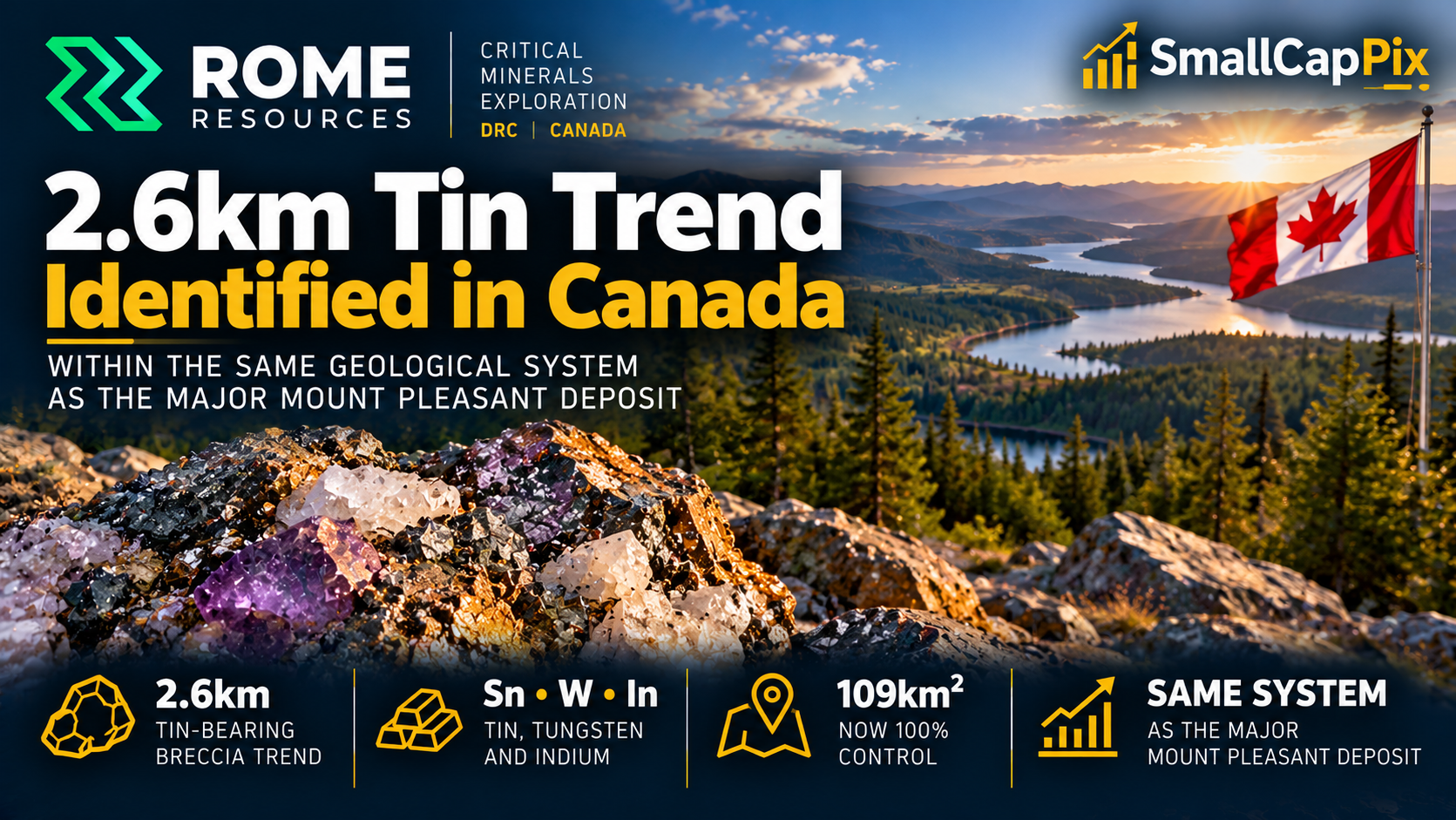
Rome Resources has identified a 2.6km tin-bearing mineralised trend at its New Brunswick project in Canada, within the same geological system that hosts the major Mount Pleasant tin-tungsten-indium deposit. With encouraging results across three exploration areas, further assays pending and a decision to acquire full control of the project, Rome's Canadian critical minerals opportunity is beginning to gather momentum.
Rome Resources (AIM: RMR) has delivered an encouraging exploration update from its New Brunswick project, where early fieldwork is beginning to reveal the potential scale of its Canadian critical minerals opportunity.
The headline development is the identification of a 2.6km tin-bearing quartz breccia trend at Scoullar Mountain, situated just a few kilometres east of the historic Mount Pleasant deposit.
Mount Pleasant is one of North America's largest known tin-tungsten-indium occurrences, making the geological relationship particularly interesting.
Crucially, Rome has identified minerals associated with the same mineralising system that created Mount Pleasant.
The company believes this raises the possibility of a larger mineralised system at depth, potentially providing attractive future drilling targets.
Although assays from the newly identified trend remain outstanding, the early geological evidence is sufficiently encouraging that Rome has decided to exercise its options and acquire full control of its New Brunswick exploration interests.
Why the 2.6km Discovery Matters
The Scoullar Mountain discovery could prove to be an important development.
Rome's geologists have mapped a 2.6km quartz breccia and porphyry zone containing stannite, a tin-bearing sulphide mineral, alongside purple fluorite.
These minerals are particularly relevant because similar mineral associations occur at the neighbouring Mount Pleasant deposit, where indium is associated with stannite, sphalerite and purple fluorite.
Finding these geological indicators on Rome's ground suggests the company is exploring within the same broader mineralising environment.
That is considerably more interesting than simply owning exploration licences near an established deposit.
CEO Paul Barrett highlighted the significance:
"We are not simply working near a world-class deposit, we are working within the system that created it."
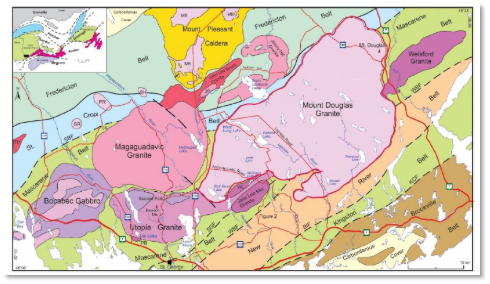 Regional setting of Rome’s New Brunswick Project. The Mount Pleasant Caldera and the Mount Douglas Granite
The company believes the surface mineralisation could represent the upper expression of a larger granite-related mineralised system at depth.
If subsequent assays and drilling support that interpretation, Scoullar Mountain could develop into a significant new tin and indium exploration target.
For now, however, the discovery remains at an early stage. The extent, grade and continuity of any potentially economic mineralisation have yet to be established.
Encouraging Results Beyond Scoullar Mountain
Importantly, the latest update isn't solely about one discovery.
Rome's 2026 exploration campaign has generated encouraging findings across three principal target areas within its New Brunswick project.
At Victoria Lake, exploration has identified mineralisation across a zone approximately 300 metres wide.
Previous sampling returned grades of up to:
- 0.58% tin
- 0.17% tungsten
Trenching has been completed across an area containing these mineralised samples, with 54 samples submitted for laboratory analysis.
A further 300 metres of trenching is planned to begin in early November.
At Square Lake, exploration has identified additional mineral occurrences, including an outcrop sample returning 0.8% bismuth.
Together, these results suggest mineralisation is present across several geological settings within Rome's wider licence area.
That gives the company multiple targets to investigate rather than relying exclusively on Scoullar Mountain.
The Indium Opportunity
One of the more interesting aspects of Rome's Canadian project is its potential exposure to indium.
While tin and tungsten remain important exploration targets, indium could provide an additional source of value if future exploration establishes economically recoverable mineralisation.
Indium is used in several strategically important technologies, including:
-
LCD and touchscreen displays
-
Data-centre electronics
-
Thin-film solar panels
-
Semiconductor applications
Unlike many other critical minerals, indium is generally recovered as a by-product of zinc and tin processing rather than from dedicated primary mines.
Its supply chain is highly concentrated, with both the United States and European Union identifying indium as a critical material facing elevated supply risks.
Earlier sampling at Rome's New Brunswick project returned 17ppm indium.
The identification of associated indicator minerals at Scoullar Mountain strengthens the geological rationale for further exploration, although it does not yet establish an economically significant indium deposit.
Nevertheless, the potential combination of tin, tungsten and indium gives Rome exposure to several strategically important critical minerals within a single Canadian project.
Rome Moves to Secure Full Control
Perhaps the strongest indication of management's confidence is its decision to exercise the options over its New Brunswick claims.
Rome will acquire 100% of the working interest in approximately 109km² of exploration ground, principally through the issuance of 225 million new ordinary shares.
The consideration shares will be subject to restrictions limiting trading to C$50,000 annually until the third anniversary of issuance.
Although the transaction introduces additional shares, it also gives Rome direct control over the project's future exploration and development strategy.
Meanwhile, its local partner has secured additional claims, increasing the land position within the Mount Pleasant Caldera sub-area to approximately 40km², immediately east and northeast of the Mount Pleasant licence.
This is strategically relevant because the company is now building a substantial position within a geological system already known to host significant critical mineral deposits.
Rather than simply maintaining a speculative exploration option, Rome is committing to the longer-term development of its Canadian portfolio.
What Happens Next?
There are several near-term developments for investors to watch.
The most immediate will be laboratory results from the newly identified Scoullar Mountain breccia trend.
These should provide a clearer indication of the grades associated with the 2.6km mineralised structure.
Results are also pending from the 54 Victoria Lake trench samples, while additional trenching is scheduled for early November.
Looking further ahead, management has indicated that Scoullar Mountain and the wider Mount Pleasant Caldera will become a major focus of its Canadian exploration programme in 2027.
The objective will be to develop the most promising targets towards potential drilling.
The SmallCapPix Take
Rome Resources is increasingly developing an interesting two-jurisdiction critical minerals portfolio.
Its flagship Bisie North project in the Democratic Republic of Congo remains central to the company's investment proposition, with its established tin exploration potential.
But New Brunswick is beginning to emerge as a potentially valuable second opportunity.
The attraction is straightforward.
Rome controls exploration ground within the same geological complex as one of North America's most significant known tin-tungsten-indium deposits.
It has now identified a substantial 2.6km tin-bearing trend, encouraging mineralisation across multiple target areas and geological indicators associated with the neighbouring Mount Pleasant system.
Importantly, management has backed those findings with a decision to acquire full control of the project.
There is still considerable exploration work ahead. Assays, drilling and ultimately resource definition will determine whether these early discoveries translate into economic value.
However, Rome's Canadian interests are beginning to look less like a peripheral exploration option and more like a credible second pillar of its critical minerals strategy.
With important assays pending and an expanded exploration programme planned for 2027, New Brunswick could become an increasingly significant part of the Rome Resources investment story.