
Blencowe Uncovers 25km Graphite Trend as Orom-Cross Reveals Potential for Much Greater Scale
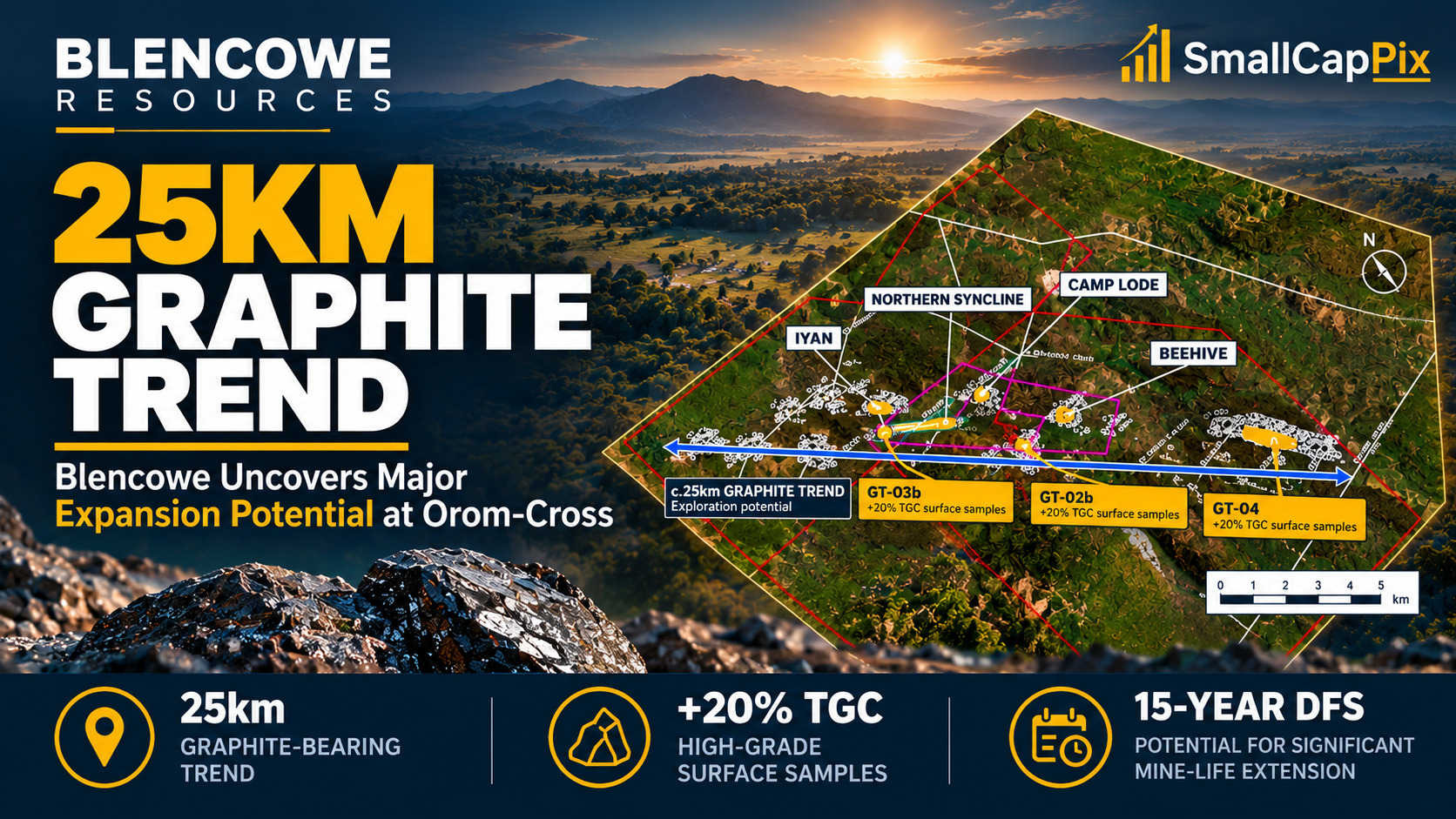
Blencowe Resources has identified graphite outcropping at surface across a 25km trend at its Orom-Cross Project in Uganda, with selected samples returning grades above 20% TGC. The findings point towards substantial exploration upside beyond the existing 15-year mine plan and strengthen the project's potential appeal to strategic partners seeking secure, long-term graphite supply.
How big could Orom-Cross ultimately become?
That's the question investors may increasingly be asking following the latest exploration results from Blencowe Resources (LSE: BRES).
The company has confirmed graphite outcropping across geophysical targets spanning approximately 25 kilometres within its existing licences, with selected grab samples from three targets returning grades exceeding 20% Total Graphitic Carbon (TGC).
Importantly, these additional targets sit outside the four deposits underpinning the company's December 2025 Definitive Feasibility Study (DFS).
For a project already designed around an initial 15-year mine life, the findings suggest Orom-Cross could potentially support a considerably longer operating future.
What's New? Graphite Identified Across a 25km Trend
Blencowe has completed its second-phase exploration programme targeting areas immediately north and south of the four deposits already drilled at Orom-Cross.
The programme followed earlier geophysical surveys that identified seven additional targets warranting investigation.
Surface mapping covered approximately 95% of the identified targets, with graphite outcropping observed across the areas investigated.
Several targets displayed extensive graphite exposures and geological characteristics comparable to those previously identified at the project's established deposits.
Perhaps most importantly, selective grab sampling returned grades exceeding 20% TGC at three targets: GT-02b, GT-03b and GT-04.
These findings provide early evidence that significant graphite mineralisation may extend well beyond the deposits currently included in the development plan.
All seven targets are located within Blencowe's existing lease areas, with the additional areas lying within approximately 10km of the proposed processing plant.
That proximity could become important should future drilling establish additional economically recoverable resources.
Understanding the Significance of 20% TGC
One of the headline figures attracting attention is the discovery of graphite samples grading above 20% TGC.
TGC refers to Total Graphitic Carbon, a standard measure of graphite grade.
Higher-grade graphite mineralisation can offer economic advantages because less material may need to be mined and processed to produce a given quantity of graphite concentrate.
However, grade is only one component of project economics. Recovery rates, flake characteristics, processing requirements and operating costs are equally important.
The latest results are encouraging because they demonstrate that high-grade graphite occurs in several additional locations across Orom-Cross.
The Emergence of a Potential Graphite District
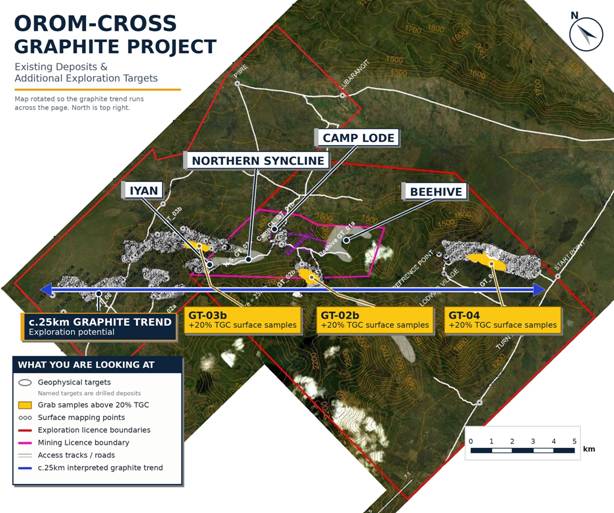
Orom-Cross deposits, including Camp Lode, Northern Syncline, Iyan (NS western limb)
and Beehive, with mapping points on additional geophysical targets across the c.25km project trend.
Until now, much of the investment case for Orom-Cross has centred on four deposits: Camp Lode, Northern Syncline, Iyan and Beehive.
These deposits form the foundation of the company's December 2025 DFS and its initial 15-year mine plan.
The latest exploration programme indicates that the geological opportunity could extend considerably further.
Rather than viewing Orom-Cross solely as a collection of four deposits, investors can begin considering the possibility of a much larger graphite-bearing district.
Blencowe has highlighted an exploration concept of 2–3 billion tonnes of graphite mineralisation across the wider project area.
That is an extraordinary figure, but it requires careful interpretation.
It is not a declared mineral resource, reserve or independently established quantity of economically recoverable graphite.
At this stage, it represents preliminary exploration potential that would require substantial additional drilling and geological modelling before any portion could potentially be converted into a compliant mineral resource.
The more immediate significance is that the company's existing 15-year development plan may represent only an initial phase of what Orom-Cross could ultimately become.
Why Mine Life and Multi-Decade Supply Potential Matter
For a commodity such as graphite, project longevity can be particularly important.
Unlike precious metals, where producers can generally sell into established global markets, graphite projects often depend upon building long-term relationships with industrial customers.
Battery manufacturers, defence suppliers and other specialist consumers need confidence that suppliers can deliver consistent material over extended periods.
Developing and qualifying a new graphite source can involve extensive testing, product development and integration into manufacturing processes.
Once those relationships are established, reliable long-term supply becomes a significant commercial advantage.
This is particularly relevant for Blencowe.
The company has already demonstrated the suitability of Orom-Cross graphite across several specialist applications, including battery materials, advanced lead-acid batteries, aerospace and defence-related products.
If future drilling confirms substantial additional resources across the wider 25km trend, Orom-Cross could potentially offer customers confidence in supply extending well beyond the existing 15-year mine plan.
This aligns closely with Western efforts to diversify critical mineral supply chains away from China, which dominates significant portions of the global graphite processing and battery-anode market.
For strategic partners seeking secure, non-China graphite supply, a project with the potential to operate for several decades could offer considerable appeal.
The latest results do not yet establish that outcome, but they provide encouraging geological evidence supporting the possibility.
Funding Remains the Immediate Priority
Despite the encouraging exploration results, Blencowe has reiterated that securing Phase 1 project funding remains its immediate focus.
The company already has a development strategy based on the four deposits included in its DFS.
The latest findings potentially enhance the long-term opportunity, but they do not remove the need to finance and construct the initial operation.
Nor do they automatically change the economics of the existing feasibility study.
For investors, the near-term catalyst remains the funding package required to move Orom-Cross towards first production.
The wider exploration programme can progress through a measured, staged approach while management concentrates on bringing the initial development into operation.
Importantly, Blencowe does not need to prove the entire 25km trend before advancing Phase 1.
Instead, it can potentially establish production from its existing development base while progressively investigating additional deposits that could extend the project's operating life.
The SmallCapPix Take
Blencowe's latest exploration results add an interesting new dimension to the Orom-Cross investment case.
Until recently, much of the story centred on demonstrating graphite quality, developing higher-value applications and securing the funding required to bring the project into production.
Those priorities remain unchanged.
However, the identification of graphite across approximately 25km of strike raises the possibility that Orom-Cross could ultimately become a much larger and longer-lived operation than its existing DFS mine plan suggests.
The presence of high-grade surface samples exceeding 20% TGC at three additional targets is encouraging, although systematic drilling will be required to establish their wider significance.
Perhaps the most compelling aspect is that all the newly investigated areas sit within Blencowe's existing licences and close to the proposed processing infrastructure.
That potentially creates a pathway for future resource growth without fundamentally changing the geographical footprint of the project.
For strategic partners seeking dependable graphite supply over several decades, this emerging picture of scale could become increasingly relevant.
The immediate investment catalyst remains Phase 1 funding. But today's announcement suggests that the initial 15-year development plan may represent only the beginning of Orom-Cross's potential.
And if subsequent exploration confirms substantial additional resources across the wider trend, Blencowe could find itself controlling one of the more strategically interesting long-life graphite development opportunities outside China and in the World.