
Harena Rare Earths: US$67 Million Funding Potential Signals Next Stage for Ampasindava
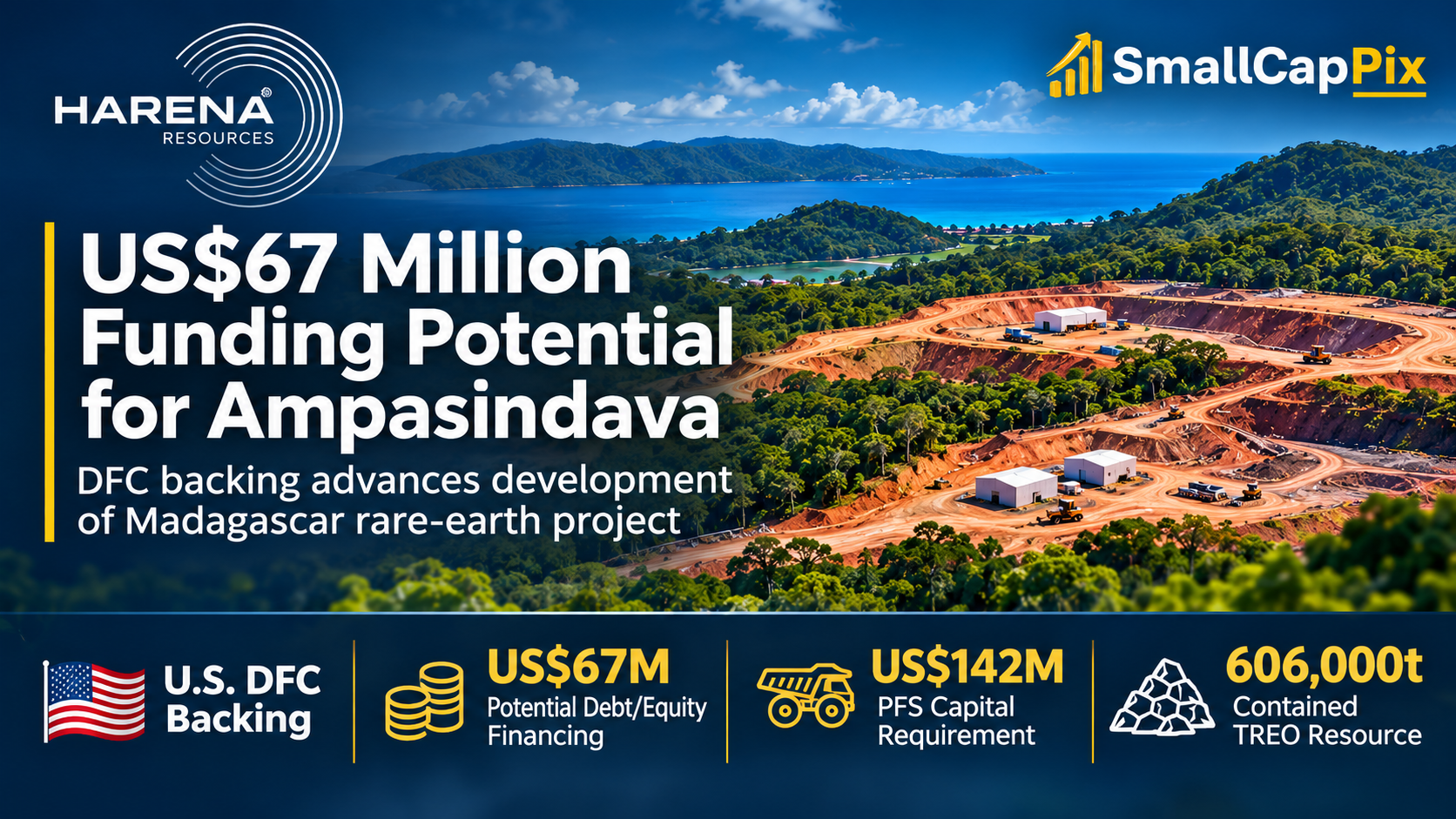
Harena Rare Earths has highlighted the potential for up to US$67 million in further debt or equity financing from the U.S. Development Finance Corporation, as its Madagascar ionic-clay rare-earth project advances towards definitive feasibility, pilot-scale development and a future construction decision.
Harena Rare Earths (LSE: HREE) has provided an encouraging update on its 100%-owned Ampasindava ionic-clay rare-earth project in Madagascar, highlighting the potential for a significantly expanded financing relationship with the U.S. International Development Finance Corporation (DFC).
The headline development is that potential future debt or equity financing of up to US$67 million is under consideration, building on Harena's existing US$4.84 million project-development funding agreement.
While this additional funding is not committed and remains subject to further due diligence and approvals, its potential significance is considerable.
Harena's completed Pre-Feasibility Study (PFS) estimated pre-production capital expenditure of US$142 million. A US$67 million package, if ultimately agreed and fully available for construction, would represent approximately 47% of that requirement.
For a junior rare-earth developer progressing towards a Definitive Feasibility Study (DFS), this could represent an important step towards establishing a credible project-financing pathway.
DFC Funding: A Potential US$67 Million Opportunity
Harena's relationship with DFC has already progressed beyond initial discussions.
The company has an agreed US$4.84 million Project Development Funding Agreement, supporting environmental studies, permitting, metallurgical programmes and preparations for its Proof-of-Concept plant.
Today's announcement confirms that Harena has received US$480,000, submitted a further US$600,000 drawdown request in October and plans to request approximately US$810,000 in January 2027, subject to the agreement's requirements.
More significantly, the existing agreement provides for DFC to consider potential subsequent debt or equity financing projected at up to US$67 million.
Any such financing would require separate due diligence, appraisal and approval, with no guarantee of a commitment.
Nevertheless, the potential scale of the funding is noteworthy, particularly given DFC's existing involvement and the strategic importance of developing alternative rare-earth supply chains outside China.
The eventual financing structure would also matter. Project debt could potentially reduce the need for shareholder equity funding, whereas an equity investment could involve dilution or changes to project ownership.
Ampasindava: A Substantial Rare-Earth Resource
Ampasindava hosts approximately 606,000 tonnes of contained total rare-earth oxides (TREO).
Its ionic-clay geology is particularly interesting because rare-earth elements are adsorbed onto clay particles rather than tightly bound within hard-rock minerals, potentially allowing simpler and less costly extraction.
The project also contains strategically important magnet rare earths, including neodymium, praseodymium, dysprosium and terbium, used in electric vehicles, wind turbines, robotics and defence technologies.
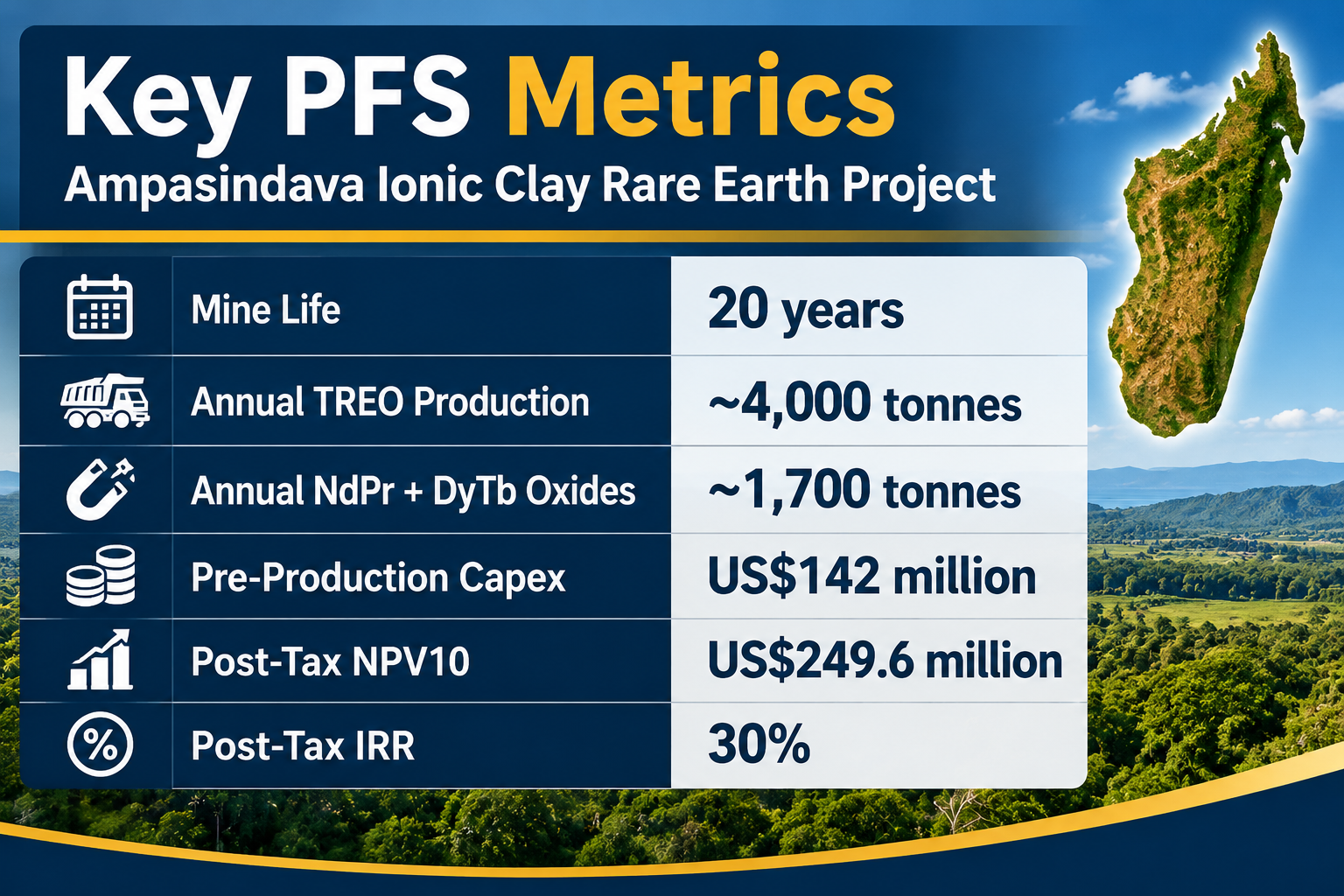
Harena's January 2026 PFS outlined a 20-year heap-leach operation producing mixed rare-earth carbonate.
The economic figures use the company's long-term analyst rare-earth pricing assumptions and remain subject to refinement through the DFS.
Technical Progress and Near-Term Catalysts
Alongside the financing update, Harena has outlined several development milestones expected to generate regular news flow.
A bulk metallurgical sampling programme is underway, with testwork designed to optimise processing recoveries, refine the flowsheet and establish design criteria for the proposed pilot plant.
Results are expected in Q1 2027.
The programme also aims to produce representative mixed rare-earth carbonate for evaluation by potential offtake partners, potentially strengthening Ampasindava's commercial proposition.
Meanwhile, Harena is progressing engineering, mine planning, logistics and cost optimisation studies to advance the PFS towards DFS level.
Construction of the onsite laboratory and Proof-of-Concept plant is targeted to commence during 2027, subject to the necessary approvals.
The regulatory position has also improved following the formalisation of Ampasindava's Exploitation Permit by the Malagasy Government.
Environmental permitting, community consultations and management plans remain the immediate priorities before pilot-phase infrastructure construction can begin.
Rare-Earth M&A Provides a Compelling Backdrop
As highlighted in our recent SmallCapPix coverage, major transactions are reshaping the ionic-clay rare-earth sector.
USA Rare Earth completed its acquisition of Brazil's Serra Verde ionic-clay operation in September 2026, following an agreement valuing the business at approximately US$2.8 billion.
Meanwhile, Lynas Rare Earths announced a proposed A$968 million acquisition of Meteoric Resources in October, targeting its Caldeira ionic-clay project in Brazil.
These transactions demonstrate increasing strategic interest in securing rare-earth resources outside China.
Although the assets are at different development stages and their valuations cannot be directly applied to Harena, the trend is relevant.
Ampasindava combines substantial resource scale, full project ownership, a completed PFS, a formalised Exploitation Permit and an increasingly established U.S. Government financing relationship.
The SmallCapPix Take
Today's announcement represents another encouraging step in Harena's progression towards becoming a potential rare-earth producer.
The US$67 million financing opportunity is particularly significant when compared with Ampasindava's US$142 million estimated pre-production capital requirement.
At approximately 47% of that figure, it illustrates how important a deeper DFC relationship could become.
Of course, this funding is not yet committed. Harena must still complete environmental permitting, demonstrate its processing approach, deliver its DFS and secure sufficient capital for construction.
Nevertheless, the direction of travel is becoming clearer.
Harena now controls 100% of a substantial ionic-clay rare-earth resource, has completed a PFS outlining potentially attractive economics, secured its Exploitation Permit and established a direct funding relationship with the U.S. Government.
Against a backdrop of substantial M&A activity across the ionic-clay sector, these developments make Ampasindava increasingly interesting.
The key question is whether Harena can convert its growing technical, regulatory and financial support into a fully financed development.
The potential US$67 million DFC financing package could become an important part of that journey.