
Harena Rare Earths Opens New Door to U.S. Investors with JPMorgan ADR Programme
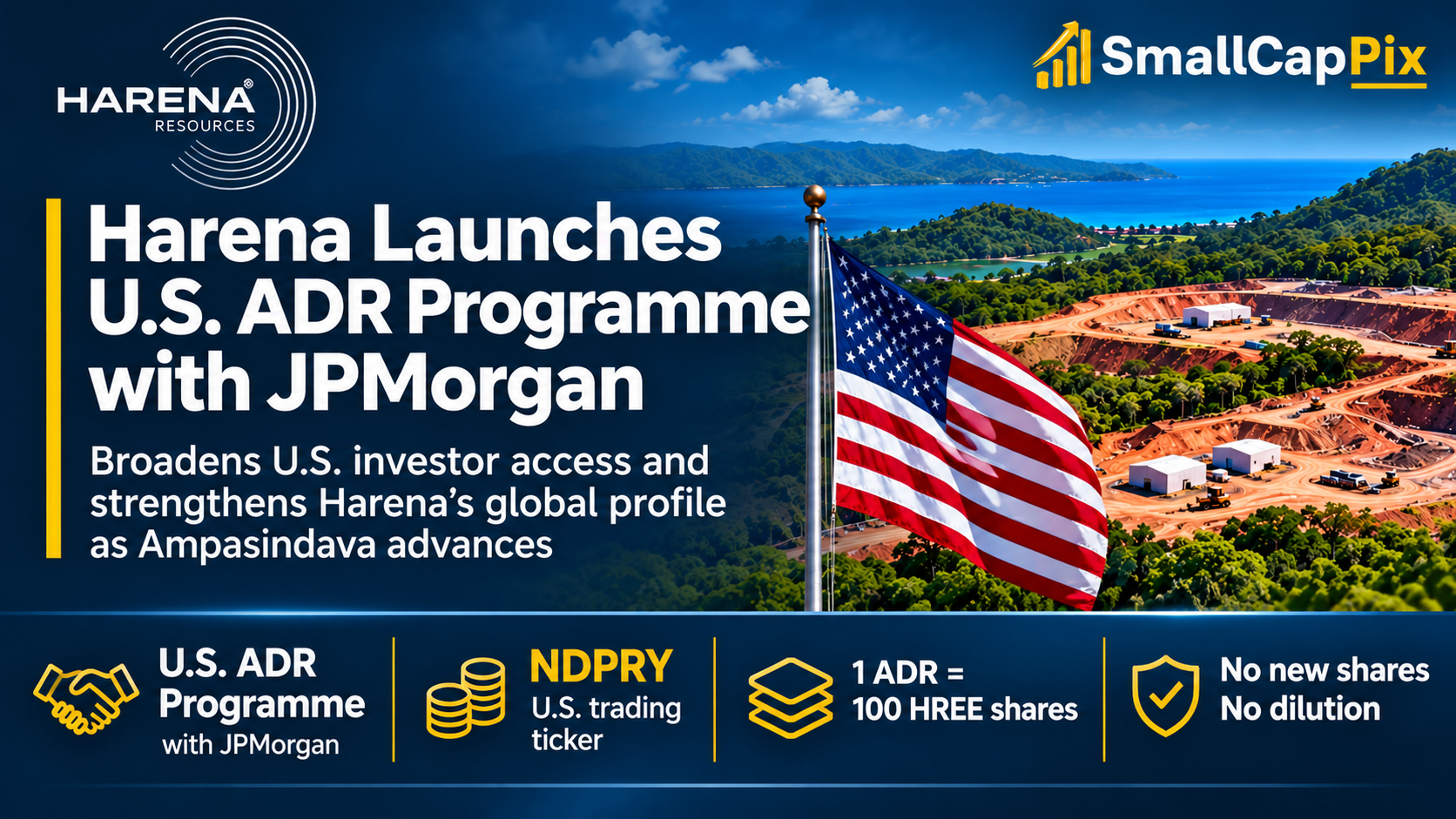
Harena Rare Earths has launched a JPMorgan-sponsored American Depositary Receipt programme, giving U.S. investors a new way to access its shares. With U.S. Government development funding already in place and potential further financing under consideration, the move strengthens Harena's growing presence in American capital markets.
Harena Rare Earths (LSE: HREE) has taken another step in expanding its U.S. investor presence, announcing the launch of a sponsored American Depositary Receipt (ADR) programme with global banking giant JPMorgan Chase.
The new programme will allow American investors to trade Harena securities in U.S. dollars under the ticker NDPRY, with each ADR representing 100 ordinary Harena shares.
Importantly, no new ordinary shares are being issued, meaning existing shareholders will not be diluted.
While the announcement doesn't directly provide additional funding for Harena's 100%-owned Ampasindava ionic-clay rare-earth project in Madagascar, it could potentially broaden the company's investor base and increase demand for its underlying London-listed shares.
And given Harena's strengthening relationship with the U.S. Government, the timing is particularly interesting.
What Exactly Is an ADR?
An American Depositary Receipt is essentially a U.S.-traded certificate representing shares in a company listed overseas.
It allows American investors to gain exposure to international companies without necessarily having to buy shares directly on a foreign stock exchange.
In Harena's case, one ADR represents 100 ordinary HREE shares.
JPMorgan acts as the depositary bank, administering the programme and arranging for the ADRs to be backed by the appropriate number of underlying ordinary shares.
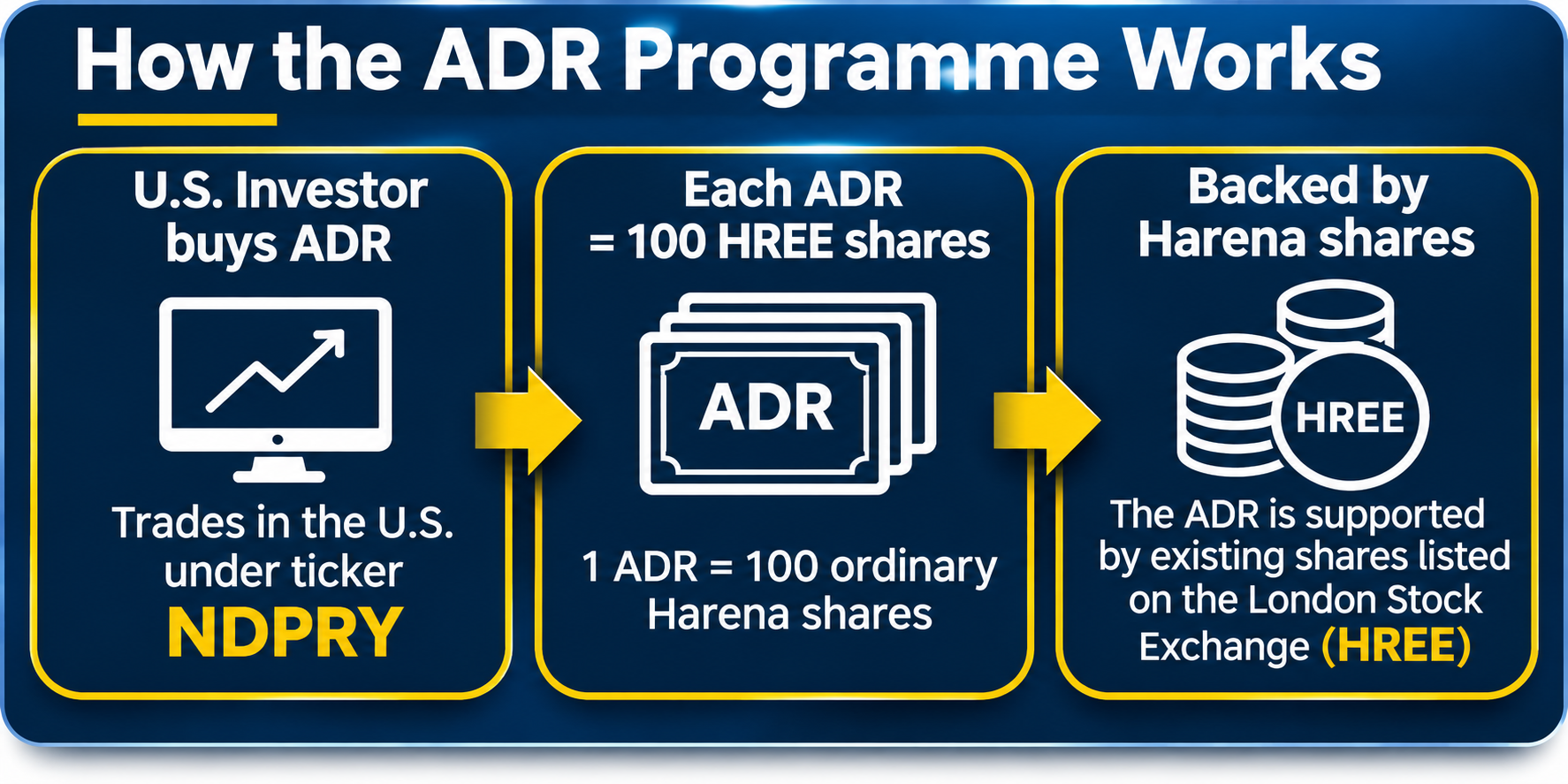
ADR Programme draws on existing UK Listed Shares - non dilutive
The ADRs trade in U.S. dollars, while Harena's ordinary shares continue trading in London under HREE.
This is a sponsored Level 1 programme, generally associated with U.S. over-the-counter trading rather than a full Nasdaq or New York Stock Exchange listing.
Harena also already has an OTCQB quotation under CRMNF, so the ADR provides an additional U.S. investment route rather than its first American trading presence.
How Could This Benefit Existing Harena Shareholders?
The potential benefit comes from creating another source of demand for Harena's existing shares.
When an American investor buys an ADR, they acquire an instrument representing 100 ordinary HREE shares.
If existing ADRs are available, they can simply purchase them from another investor.
However, if demand requires additional ADRs to be created, market participants can acquire ordinary Harena shares, potentially through the London market, and deposit them with JPMorgan's custodian.
JPMorgan can then issue the corresponding ADRs.
For example, if American investor demand resulted in the creation of 100,000 new ADRs, those receipts would need to be backed by 10 million existing Harena ordinary shares.
That is where the potential benefit for London shareholders emerges.
If American interest increases significantly, it could generate additional demand for the underlying ordinary shares, potentially improving liquidity and supporting the share price.
There is no guarantee of increased demand, however. Existing ADRs can trade between investors without triggering purchases in London.
Crucially, the ADR programme does not create new ordinary shares or dilute existing shareholders.
Why Is Harena Targeting American Investors?
The move fits neatly into Harena's wider U.S. strategy.
Ampasindava hosts approximately 606,000 tonnes of contained total rare-earth oxides (TREO), including strategically important magnet rare earths such as neodymium, praseodymium, dysprosium and terbium.
These materials are essential for permanent magnets used in electric vehicles, wind turbines, robotics, advanced manufacturing and defence technologies.
With the United States actively seeking alternative sources of critical minerals outside China, projects such as Ampasindava have growing strategic relevance.
Harena has already secured a US$4.84 million Project Development Funding Agreement with the U.S. International Development Finance Corporation (DFC), with funding drawdowns underway.
More recently, the company highlighted the potential for up to US$67 million in further debt or equity financing to be considered by DFC, although this remains subject to due diligence and approval and is not committed.
The U.S. Government has also publicly recognised Ampasindava's strategic importance through a White House critical-minerals announcement.
Against that backdrop, establishing an ADR programme gives Harena another channel through which to engage American investors interested in critical minerals and supply-chain security.
Ampasindava Continues to Advance
The ADR announcement follows a series of important development milestones.
Harena now owns 100% of Ampasindava and has completed a Pre-Feasibility Study outlining a 20-year operation producing approximately 4,000 tonnes of TREO annually.
The study estimated pre-production capital expenditure of US$142 million, alongside a US$249.6 million post-tax NPV10 and 30% post-tax IRR, based on the company's long-term analyst pricing assumptions.
The project's Exploitation Permit has also been formalised by the Malagasy Government.
Harena is now progressing environmental approvals, metallurgical testwork and preparations for its Proof-of-Concept pilot plant, with further technical results expected during Q1 2027.
These remain the milestones most likely to influence Ampasindava's eventual development and financing prospects.
The SmallCapPix Take
We view the JPMorgan-sponsored ADR programme as another positive step in Harena's evolving U.S. strategy.
It doesn't provide immediate project funding, nor should JPMorgan's appointment be interpreted as the bank making an investment in Harena.
However, it makes the company more accessible to American investors at a time when the U.S. Government is actively supporting efforts to diversify rare-earth supply chains and US Investors are looking for Rare Earths exposure.
The potential benefit for existing HREE shareholders is straightforward: additional U.S. demand could translate into buying interest in the same underlying ordinary shares traded in London—without dilution.
Combined with existing DFC development funding, the possibility of substantially larger financing and ongoing project milestones, the ADR programme adds another piece to Harena's increasingly international investment story.
For a relatively small London-listed rare-earth developer, expanding access to one of the world's largest investment markets could prove valuable as Ampasindava moves closer to a construction decision.