
Central Asia Metals – A New Copper Powerhouse in the Making?

With its shares under pressure, could investors be overlooking the transformational potential of Central Asia Metals' Canadian acquisition? The Chibougamau copper-gold project, an accelerated development programme and strong cash flows from existing operations could provide a pathway towards doubling annual copper production, with the added attraction of gold and silver revenues.
Whilst drawing on officially published company data, this article also includes illustrative calculations and production scenarios to highlight the potential of CAML's growth assets. These are SmallCapPix estimates and assumptions, not official company forecasts or production guidance.
Is the Market Overlooking the Bigger Picture?
One of the longstanding concerns surrounding Central Asia Metals (AIM:CAML) has been the finite operating lives of its two producing assets: Kounrad in Kazakhstan and Sasa in North Macedonia.
It's a perfectly legitimate concern, but valuing a mining company purely on the remaining production of its existing operations potentially overlooks management's ability to reinvest cash flows into new producing assets.
CAML's recent acquisition of Cygnus Metals could fundamentally change that equation.
The company is no longer simply managing two mature mining operations. It is actively building a development and exploration portfolio designed to provide the next generation of production.
The interesting question for investors is whether the current share price adequately reflects that opportunity.
A Highly Profitable Business Today
Before looking at CAML's future, it's worth remembering the strength of its existing business.
The company's H1 2026 financial results made impressive reading:
-
Revenue: $145.5m, up 46%
-
EBITDA: $75.5m, up 89%
-
Adjusted free cash flow: $46.8m, up 189%
-
EBITDA margin: 52%
-
Interim dividend: 8p, up 78%
That operational momentum continued into Q3, with zinc and lead production increasing by 18% and 21% respectively year-on-year, while average realised copper prices reached $14,218 per tonne, up 43%.
This is particularly important because CAML has something many mining development companies lack: established, profitable operations capable of generating meaningful cash flow to help finance its next phase of growth.
Kounrad – Still a Significant Cash Generator
Kounrad is undoubtedly a finite resource, with copper production expected to decline as recoverable material within its historical waste dumps becomes depleted.
However, its existing production schedule illustrates that this is a gradual transition rather than an imminent production cliff.
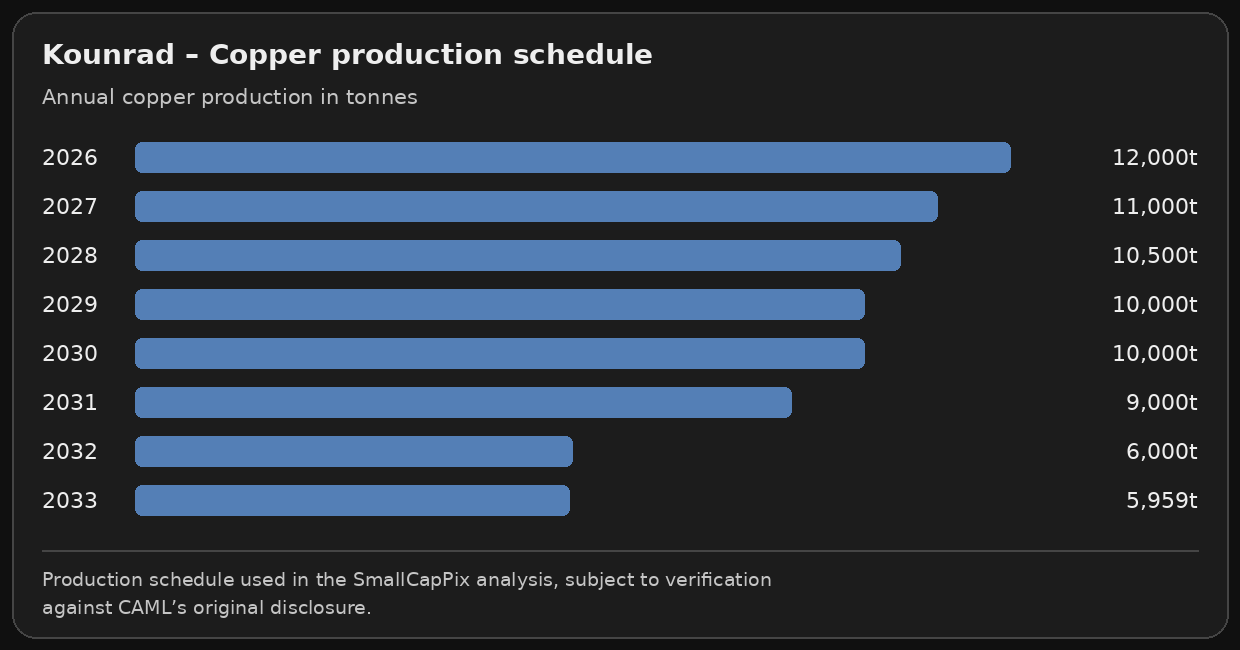
What stands out is that Kounrad could continue producing around 10,000 tonnes of copper annually through 2030.
At an illustrative copper price of $14,000 per tonne, that represents $140m annually in gross metal value before operating costs, taxes and other deductions.
CAML therefore has several years in which Kounrad could continue generating substantial cash while its next major copper asset is developed.
Meanwhile, Sasa's existing mine-life outlook extends to 2034, with potential for further resource conversion and mine-life extension, subject to technical and economic evaluation.
Chibougamau – A Potentially Transformational Acquisition
The acquisition of Cygnus Metals brings the Chibougamau copper-gold project in Québec, Canada, into CAML's portfolio.
The project's existing published mineral resource comprises:
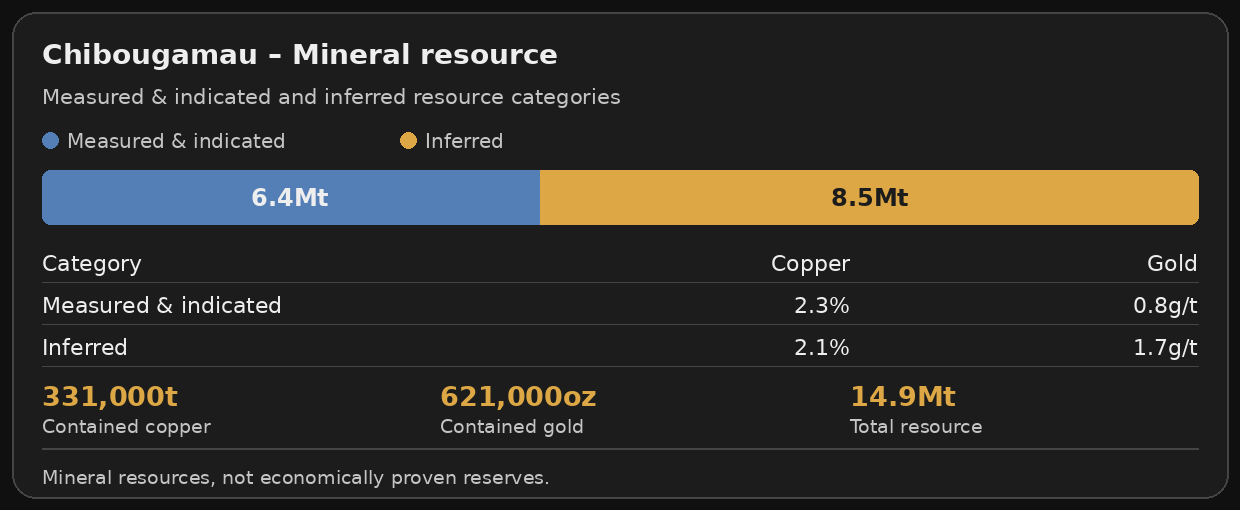
In total, the project contains approximately:
-
331,000 tonnes of copper
-
621,000 ounces of gold
-
3.73 million ounces of silver
These represent mineral resources rather than economically proven reserves, but the scale and grades provide an encouraging starting point.
Perhaps equally important is the existing 900,000-tonne-per-annum historical processing facility at Copper Rand, with five key deposits located within 50km.
The potential to refurbish existing infrastructure and establish a central processing hub, fed by multiple underground mining operations, could offer meaningful advantages in terms of development costs and timescales compared with an entirely new mine.
Could CAML Become a Much Larger Copper Producer?
This is where the Canadian acquisition becomes particularly interesting.
Using Chibougamau's historical processing capacity, indicative resource grades and assumed metallurgical recoveries, we can illustrate what a successful development might achieve.
Our assumptions are:
-
Annual processing capacity of 900,000 tonnes.
-
Average copper feed grade of 2.2%.
-
Average gold feed grade of 1.3g/t.
-
Copper recovery of 90% and gold recovery of 85%.
Based on these assumptions, potential annual production at different levels of plant utilisation would look like this:
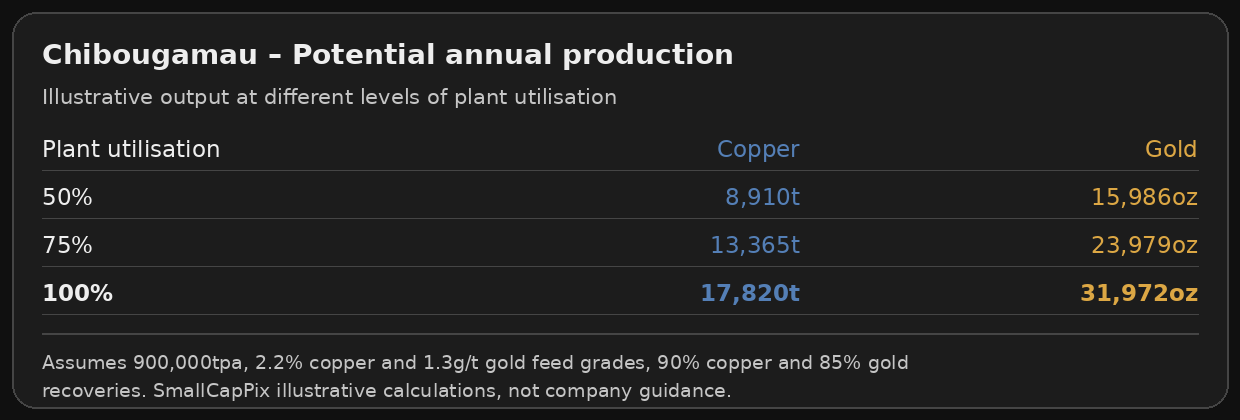
Even at 75% of historical plant capacity, Chibougamau could theoretically exceed Kounrad's current annual copper production guidance midpoint.
At full capacity, the operation could potentially produce around 18,000 tonnes of copper and 32,000 ounces of gold annually.
Furthermore, the existing 14.9Mt mineral resource is equivalent to approximately 16.6 years of processing at historical plant capacity, before accounting for any further resource expansion.
Importantly, these are illustrative SmallCapPix calculations, not company production forecasts or a declared mine life. Actual output will depend on resource conversion, mine planning, dilution, metallurgical recoveries and achievable processing capacity.
Nevertheless, the numbers illustrate why Chibougamau could potentially do considerably more than simply replace Kounrad.
What Could CAML's Production Look Like Over the Next Decade?
Assuming first Canadian production in 2030, followed by a phased ramp-up, an illustrative group copper production profile might look like this:
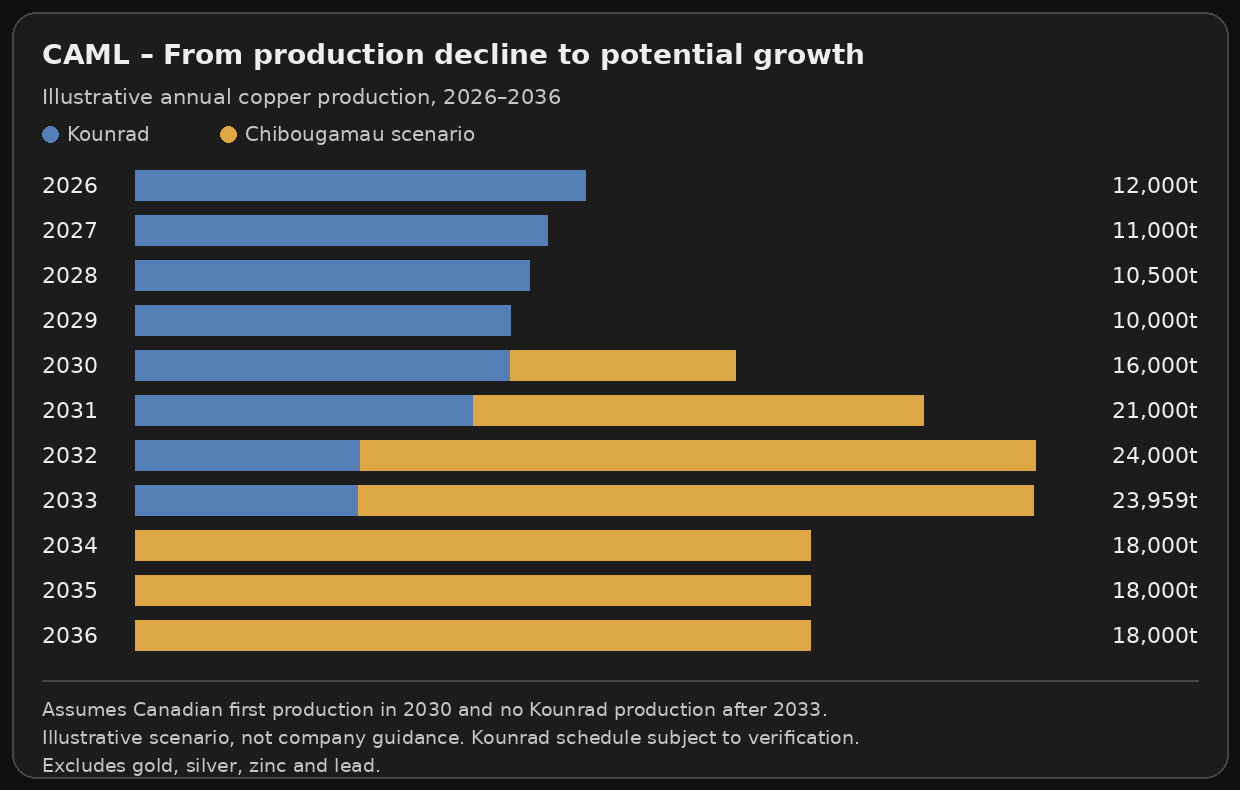
Chibougamau production volumes and commencement dates are illustrative SmallCapPix assumptions, not CAML guidance. The scenario assumes no Kounrad production after 2033.
Under this scenario, CAML could temporarily double its existing copper production during the period when both operations overlap, before settling at an annual production rate approximately 50% higher than the lower end of its current copper production guidance.
And that excludes potential Canadian gold and silver production, alongside any further exploration successes.
Management Is Already Accelerating Development
CAML's 12 November Chibougamau project update provides encouraging evidence that management intends to progress the Canadian asset at pace.
The company has outlined:
-
Up to 70,000 metres of drilling through to the end of 2027.
-
An expanded Preliminary Economic Assessment (PEA) targeted for mid-2027.
-
An updated Mineral Resource Estimate in Q3 2027.
-
Metallurgical and geotechnical work supporting future feasibility studies.
-
Environmental assessment preparation and groundwork for processing facility rehabilitation.
With approximately 57% of the current mineral resource classified as Inferred, successful resource upgrading could be particularly significant.
The wider 282km² land package also provides considerable exploration upside.
Beyond these studies, CAML will need to secure the necessary permits, develop underground mining operations, refurbish the processing facility and commit the required development capital.
The forthcoming PEA should provide investors with much greater clarity on potential production rates, development costs, operating margins and project economics.
Further Growth Beyond Canada
Chibougamau isn't CAML's only growth opportunity.
In Kazakhstan, maiden drilling at Yuzhnoe has identified copper mineralisation over more than one kilometre of strike, with further drilling planned.
The Teniz Basin project is also progressing towards drilling, while CAML holds a 38.9% interest in Aberdeen Minerals, which is exploring for nickel, copper and cobalt in Scotland.
These earlier-stage opportunities are not included in our illustrative production scenario, providing additional potential upside should exploration prove successful.
The SmallCapPix Take – A Compelling Contrarian Investment Opportunity?
With CAML's shares under pressure, we believe the Canadian acquisition deserves considerably more attention.
The risks are clear. Developing Chibougamau will require substantial investment, successful technical studies, permitting and disciplined execution. Canadian operating costs may be higher than Kounrad's, while development expenditure could put pressure on future dividends.
There is also no guarantee that Canadian production will commence before Kounrad's output declines materially.
However, CAML enters this development phase from a position of operational and financial strength, with profitable existing assets capable of helping fund its growth ambitions.
Against a backdrop of rising long-term copper demand from electrification, renewable energy, power infrastructure and data centres, the timing of its Canadian expansion could also prove favourable.
If the market is currently placing insufficient value on Chibougamau's development potential, today's depressed share price could represent an attractive longer-term entry point for investors willing to accept the associated development risks.
The 2027 economic assessment and resource update could prove important valuation catalysts.
Rather than viewing CAML as a mining business approaching the end of its production cycle, perhaps investors should increasingly consider it as an established, cash-generative producer investing in the beginning of its next one.
If Chibougamau delivers, Central Asia Metals could ultimately emerge as a substantially larger and more diversified copper producer, with the added attraction of meaningful gold and silver revenues.
A new copper powerhouse in the making? The next 12 to 18 months could go a long way towards answering that question.